
“Hep” cats


The great Alfred Hitchcock movie of 1963 wasn’t made by Hitchcock — it was the wonderful thriller called Charade.
I wrote about a lot of movies in the past, and the hardest ones to write about are the very good ones. What is there to say? It was really good! Go see it! What’s a critic to criticize?
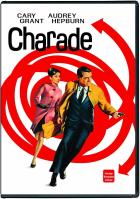
Country: United States.
Director: Stanley Donen.
Writer: Peter Stone.
Based on: the novel The Unsuspecting Wife by Peter Stone, Marc Behm.
Cast includes: Audrey Hepburn, Cary Grant, Walter Matthau, James Coburn, George Kennedy.
Links: Wikipedia, IMDB
#10, US box office
Golden Globes:
Actor musical/comedy (nominated)
Actress musical/comedy (nominated)
Keywords: paris.
Set in era: contemporary.
Is it well known? well known.
Had I seen this before? long ago on video.
Overrated? underrated.
Charade used to be on TV regularly when I was a kid, for what I now realize were two reasons: 1. It’s a really fun watch, and 2. according to Wikipedia, they forgot to put a © next to the date, so it went into the public domain.
The story starts with a dead body thrown from a train somewhere in Europe, and we then cut to the body’s brand-new widow, Regina, played by Audrey Hepburn, lunching in a mountain chalet. She is obligated to return to Paris, where intrigue awaits.
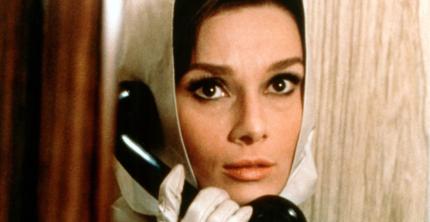
It seems that her husband was in possession of a stolen quarter-million dollars (that would be a zillion dollars today), and somebody out there will stop at nothing to get hold of the mysteriously disappeared money. Into the mix steps Cary Grant, promising to protect her from the villains, who will start to show their faces at any moment.
At the risk of being boringly uncritical, let me attempt to say what’s (still!) great about Charade.
The first thing is, there isn’t a scene that doesn’t ramp up the intrigue or cast doubt on what you think is happening. Just to pick an early scene, a funeral is held for the dead man, with only a few people in attendance, including a Paris detective who is eyeing the proceedings for clues. Each of the three potential bad guys shows up to pay disrespects to the body, which is how we meet them. James Coburn stops to address the unsuspecting widow in a Texas accent, saying, “Charlie had no call of doin’ it that way. No sirree.” Wait, who is this? What is that about? We’ve got to know! Then multiply that scene times thirty. It’s just a masterpiece of storytelling.
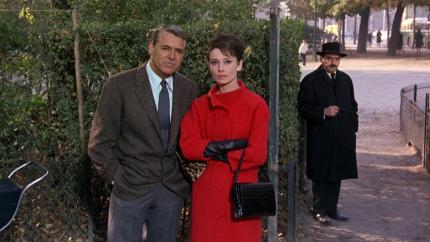
The second thing is, obviously, you get both Cary Grant and Audrey Hepburn at their very best. In the commentary for the Criterion disc, director Stanley Donen says he was passing the time with Grant during the shoot (pre-IMDB, obviously) and they tried to count up his leading ladies from Shirley Temple forward, losing count around 65. I thought about this rewatching the movie — how blessed he was to work opposite Katharine Hepburn (no relation to Audrey!), Ingrid Bergman, Rosalind Russell, Eva Marie Saint, and so on and so on, and then Audrey Hepburn. They are a great match, but what’s even better is, it’s her movie. In fact, it’s constantly unclear which side he’s even on, and she has to outsmart him as well as every other man in the movie. Which she does.
In just one sample of the great interplay between the two, at one point she has pierced his false identity, and she calls him on the phone:
“Good morning, Mr. Dyle,” she says, drily.
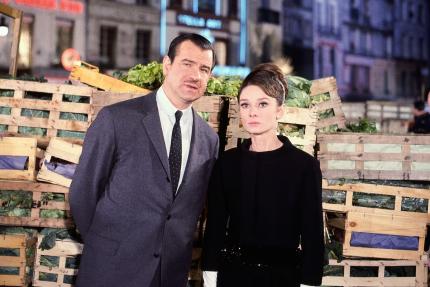
He pauses and realizes he’s been found out. “Reggie?” he says.
“It’s the only name I’ve got. How about you?” she retorts.
Another time he gets slashed in the back, and she dresses his wounds. “It’s not too bad,” she says when she’s finished. “You won’t be able to lie on your back for a few days . . . but then you can lie from any position.”
This is my first month of articles for OPFM, focusing on the year 1963, and honestly Charade is my favorite. I don’t think film-studies classes are teaching it — not when there are much more celebrated Godard, Bergman, Kurosawa and Fellini entries from that year — and if you want to teach Hitchcock you even have The Birds. Charade wasn’t nominated for any Academy Awards except best song, and it was only a respectable #5 on critics’ lists and #10 at the box office. But it’s just a joy — it was then, and it is now.
Notes
1. In an obviously Hitchcockian motif, director Stanley Donen has a walk-on part in the movie, as a man in an elevator. He may — you can decide — lack Hitchcockian recognizability.
2. The audio commentary track on the Criterion disc is a joy almost equal to the movie itself. Director Donen is joined by writer Peter Stone, both of whom have almost the same New York-accented voice so it’s a little hard to tell who’s who. They drop some insights into the movie, which are great, but they spend an equal amount of time bickering over the details like an old married couple. It’s fantastic.
Example:
“They hadn’t tried in a very long time. It’s called black comedy, and there hadn’t been a successful one since the late ’30s, and it interested me as a genre to do suspense and menace side by side with comedy.”
“Oddly, there was the belief that this was a genre that was popular. It wasn’t, because no one was making them — not even Hitchcock, really.”
“Well, they tried. They tried to make comedy-adventure movies. Most of them failed. I can’t remember any off the top of my head.”
“I can’t remember if this was made before North By Northwest or after.”
“After. It was after.”
Oh, right, that movie North By Northwest, which is exactly what you’re saying they didn’t do before this movie. The twisting of the knife is exquisite.
3. There’s another fascinating item while Hepburn and Grant walk along the Seine and talk about where their story stands. “I mean, any minute now we could be assassinated,” she says.
Stone explains that the movie was to have its first screening at Radio City Music Hall in November 1963 — the very month of the JFK assassination.
“I woke up — I said, ‘My God, the word “assassinated” is in the script, twice in fact, in this scene.’ You have no idea what that word was like. It was about to open at the Radio City Music Hall, and it would have been just awful. So I called the studio and said, ‘We’ve got to do something about this.’ And I lay awake all night figuring out a word that could dub it, and the only word I could find was ‘eliminated,’ and it was cut into the movie. And it was like that for the first many, many years.”
In today’s version, the original “assassinated” line is back, however.
“I recently saw it on television and I’m astonished that it’s back in, and I don’t know who did that,” Stone says. Who done it, indeed.
4. With all the fancy-pants directors who released movies in 1963 . . . Pauline Kael agreed with me!
I couldn’t persuade friends to go see Charade, which although no more than a charming confectionery trifle was, I think, probably the best American film of last year--as artificial and enjoyable in its way as The Big Sleep. The word had got around that it isn’t important, that it isn’t serious, that it doesn’t do anything for you."Are Movies Going to Pieces,” The Atlantic, December 1964
Oh, but it does. It gives you a perfect night at the movies. And that’s what the movies are for.
Movie infoYear: 1963.
Country: United States.
Director: Stanley Donen.
Writer: Peter Stone.
Based on: the novel The Unsuspecting Wife by Peter Stone, Marc Behm.
Cast includes: Audrey Hepburn, Cary Grant, Walter Matthau, James Coburn, George Kennedy.
Links: Wikipedia, IMDB
Awards & distinctions#5, Critics' average (1963)
#10, US box office
Golden Globes:
Actor musical/comedy (nominated)
Actress musical/comedy (nominated)
Watch notesGenre: romance, spy, thriller.
Keywords: paris.
Set in era: contemporary.
Is it well known? well known.
Had I seen this before? long ago on video.
Overrated? underrated.
Copyright 2026 by the author.