
Hud just about enough


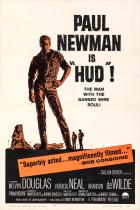
As the poster promises, Paul Newman is Hud, “the man with the barbed wire soul.”
That was 1963. What we would call him today is “the man with the MAGA hat.”
Country: United States.
Running time: 112 minutes.
Director: Martin Ritt.
Writer: Irving Ravetch, Harriet Frank Jr..
Based on: the novel Horseman, Pass By by Larry McMurtry.
Cast includes: Paul Newman, Melvyn Douglas, Patricia Neal, Brandon deWilde.
Links: Wikipedia, IMDB
Keywords: antihero.
Set in era: contemporary.
Is it well known? well known.
How did I see it? home.
Had I seen this before? never before.
Compared to book: haven’t read it.
#20, US box office
Academy Awards:
Actress (winner)
Supporting actor (winner)
Adapted screenplay (nominated)
Cinematography (b/w) (winner)
Director (nominated)
Actor (nominated)
Golden Globes:
Best drama (nominated)
Actor drama (nominated)
Director (nominated)
Supporting actor (nominated)
Supporting actress (nominated)
BAFTA awards:
Best film (nominated)
Foreign actor (nominated)
Foreign actress (winner)
It’s worth thinking about what a different world it was when Larry McMurtry’s novel about small-town Texas (titled “Horseman, Pass By") was filmed. We were one year away from passage of the Civil Rights Act and the white South was solidly Democratic in terms of party, in a deal-with-the-devil alliance with northern liberals, not yet stung by that existential betrayal.
And so it’s a different landscape in which we meet Hud. He is a creep in every way — but noticeably, he’s the only one in town. He’s a brawler, drunk all the time, and he’s seen romancing married women of the town regularly. (Would a married woman really have an open affair in front of her neighbors in a small rural town like this? It doesn’t feel true. Anyway . . .)
The biggest plot point in the movie is that a couple of cows die mysteriously on Hud’s elderly father Homer’s ranch, and foot-and-mouth disease is suspected. If the state finds they have the disease, all the cattle will have to be put down, at a total loss to the family.
Hud, who has his eye on inheriting the ranch someday soon, is irate and says he’ll recklessly sell the cattle off to others before the state can test them.
“And take a chance on startin’ an epidemic in the entire country?” wise, responsible old Homer asks.
“Why, this whole country is run on epidemics,” Hud snaps back. “Epidemics of big business price-fixing, crooked TV shows, income-tax finaglin’, souped-up expense accounts. How many honest men you know?”
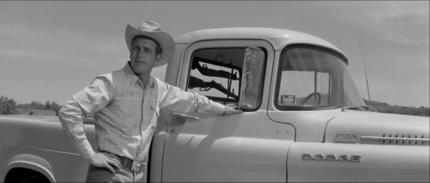
The movie is about decency vs. indecency, and on its own terms, it borders on cartoonish in that Hud is such a bad soul while everyone else is really sweet. It is not a movie about the same place and people 63 years later, but if it were, it would have to be vastly more complicated.
Today, Hud (who drives a flashy Cadillac convertible) would be one of, well, numerous men in town who drive oversized pickup trucks, some of them flying giant Trump flags. I’ve been to the Texas panhandle and elsewhere around the South in recent years, and there’s a range of people and the people are cordial to your face for sure, but the fabric of society is subconsciously to overtly MAGA. It’s not one guy, at least anymore.
People, a lot of them, try to be decent, and in 1963 it was possible to tell this story based on a “just do what’s right” ethos vs. “occasionally there’s a bad apple,” because the social fabric wasn’t politicized quite the way it is now. But we’re being shown a bit of a false ideal in which all the people but Hud are pure and good. It’s true that Hud the movie is selling “the barbed wire soul” as a single plot point, but it’s also kind of selling Mayberry.
(Incidentally, there is a truly excellent — and little-seen — movie that does show the complexity of people in contemporary rural Texas called Vengeance, written and directed by BJ Novak in 2022, and currently on Netflix. I’ll write about that one another time. But see it!)
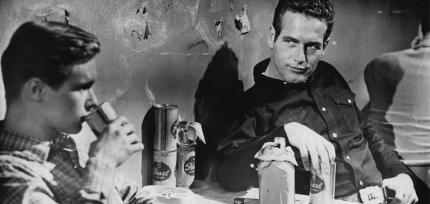
There are two more people in Hud’s circle, one of whom is his teen nephew, Lonnie (played by Brandon deWilde, who was also the boy in Shane). Lonnie is the moral arbiter of the movie, wanting to be a man like Hud, but troubled by his brutish traits. This kind of character is familiar from stories before and after this one — he’s going to tell us whether our antihero has changed himself for the better or gone to the dark side. As far as the importance of Lonnie, we can just leave it at that. The hero’s prize to win or lose at the end of many movies is usually the girl, but here it’s Lonnie.
The other key character is Alma, the caretaker of the ranch house, and she is a lot more interesting. Her job is to tolerate the uses and petty abuses of the family she works for, and at first I thought she was the mom and had no choice in her fate, but no, she just has a paying job that comes with a spare room in a side cabin on their property in the middle of nowhere.
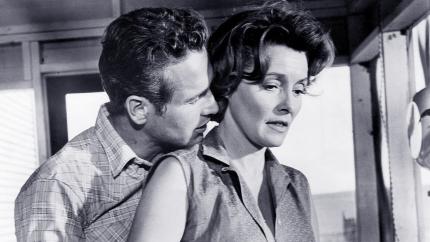
One day (spoiler to follow), a drunken Hud, who as the handsomest man around is used to having his way with any woman he sees, goes to the cabin and tries to rape Alma. It’s a horrifying scene, and is interrupted only when Lonnie breaks it up.
It’s interesting that the movie makes these choices. In the McMurtry book (which I didn’t feel like reading so I’m relying on Wikipedia here), Alma is a black servant named Halmea, and the rape is not interrupted. In neither telling does Hud face consequences. It’s hard to imagine that version of Hud ever getting made.
In the end, Alma just timidly packs up and leaves town. Hud sees her off at the station and says, “I’ll remember ya, honey — you’re the one that got away.” Obviously, he just means the conquest, not the love of his life.
Her response is that if he’d been patient she probably would have given him sex because he’s so attractive. And then she leaves.
I just hate this ending for her. She was set up with the opportunity to be a strong character, but she never is. She even makes it okay for him.
The movie ends with a really improbable coincidence, and the book ends with a variation on it that’s slightly less coincidental but has more evil in it. I don’t like it. It’s bad writing.
The movie was written to be a sort of hard-boiled modern-day western, and it just isn’t as engaging as it needed to be. We’re supposed to be fascinated by Hud the antihero (modern-day term), but I’m not. He’s a series of bad behaviors more than a person. What is this movie even trying to say about the man with the barbed wire soul? I have no idea.
Notes
1. Weirdly, director Martin Ritt, screenwriters Irving Ravetch and Harriet Frank Jr. (a married couple), stars Paul Newman and Melvyn Douglas, and for good measure, composer Elmer Bernstein, all Jewish. I don’t detect anything noticeably Jewish about the film or the characters.
2. According to Wikipedia, quoting two books on the subject:
Paramount executives were unhappy with the film. They felt it was too dark and were displeased by the black-and-white cinematography and Hud’s lack of remorse and unchanged behavior. Although Martin Rackin asked Ritt to change the film’s ending, Newman and he decided to keep the original. After Hud was previewed, Paramount considered dropping the project, feeling that it was not “commercial enough,” but Ritt flew to New York and convinced the executives to release the film unmodified.
3. The film’s writers and director were also dismayed by the public’s embrace of the antihero Hud:
“We sensed a change in American society back then,” Ravetch said in 2003. “We felt that the country was gradually moving into a kind of self-absorption, and indulgence, and greed.” As Ritt told another interviewer in 1983, he wanted to make a film about a man who was “committed to his appetite and only to his appetite.” It was the kind of character that, in most Hollywood movies to date, would have been fully chastened and reformed by the third act. But Hud would earn no redemption. “Why don’t we take that kind of American hero,” Ritt said, “and show that he really is a jerk?”
To their shock, however, the audience didn’t think Hud was a jerk. “The kids loved Hud,” Ritt lamented. “That son of a bitch that I hated, they loved.” The film’s many teenaged fans hung Hud posters in their bedrooms, and they wrote letters to Ritt to tell him how Hud was right. Newman bemoaned in the magazines that his character’s utter repugnance seemed to have slipped right by most of them—that he couldn’t believe that “all they saw was this Western, heroic individual.”
How ‘Hud’ Began Texas’s Love Affair With the Bastard, Texas Monthly
The conversation
No, no, no! This is exactly wrong, for reasons I’ve laid out in the review above. Alma is NOT noble for just suffering through her rape attempt and then going away sheepishly. She is wrongly made a doormat, although I do think this illustrates a mindset of the time, which was that men will get a little out of hand sometimes and women just have to fight them off and fix their makeup and maintain their poise about it as ladies. (Pauline Kael kind of reinforces this in the article linked below.) Here’s the kind of gross view from 1963:
The boy is, of course, the usual uncertain, impressionable youth whose character is being affected by forces outside himself, and the housekeeper is the eternal woman who serves and suffers the whims of men. Her conduct in this situation is a noble, moving tribute to her sex.
Bosley Crowther, Hurrahs for ‘Hud': A Present-Day Western Drama Has an Apt, Compelling Theme, NY Times, 1963
Here is a really good statement from a still mostly enthusiastic 1963 review, about why Hud isn’t interesting as an antihero:
Poor Hud is of a cheap meanness all compact, and at no point are we given a glimpse of why. He is indefatigably, gratuitously bad, but in the climactic scene between him and his father, as we wait to discover what has turned him into what he is from what he must have been (Wasn’t he once a Lon? Weren’t we all Lons?), the father says only, “You never gave a damn.” Which tells us nothing, and it is just this gap that, had it been filled, might have made “Hud” a great picture instead of a good one.
Brendan Gill, The New Yorker, 1963
Pauline Kael wrote a long look back at Hud the following year, including a roundup of all the critics who gushed over it, and she seems quite skeptical but then ends with, “No, but it’s a good movie.” (Hey, what if it actually isn’t a good movie?)
I’m not going to copy it here because it’s basically one big spoiler, but there’s a climactic scene in the film that I haven’t mentioned, and she analyzes the scene and the misinterpretation of it quite well. Read for yourself if you want.
I recommended Hud to friends . . . and was bewildered when they came back indignant that I’d wasted their time. I was even more bewildered when the reviews started coming out; what were the critics talking about? Unlike the laughing audience, they were taking Hud at serious message value as a work of integrity, and, even in some cases, as a tragedy.
Pauline Kael, Hud, Deep in the Divided Heart of Hollywood, Film Quarterly, 1964
Country: United States.
Running time: 112 minutes.
Director: Martin Ritt.
Writer: Irving Ravetch, Harriet Frank Jr..
Based on: the novel Horseman, Pass By by Larry McMurtry.
Cast includes: Paul Newman, Melvyn Douglas, Patricia Neal, Brandon deWilde.
Links: Wikipedia, IMDB
Keywords: antihero.
Set in era: contemporary.
Is it well known? well known.
How did I see it? home.
Had I seen this before? never before.
Compared to book: haven’t read it.
#20, US box office
Academy Awards:
Actress (winner)
Supporting actor (winner)
Adapted screenplay (nominated)
Cinematography (b/w) (winner)
Director (nominated)
Actor (nominated)
Golden Globes:
Best drama (nominated)
Actor drama (nominated)
Director (nominated)
Supporting actor (nominated)
Supporting actress (nominated)
BAFTA awards:
Best film (nominated)
Foreign actor (nominated)
Foreign actress (winner)