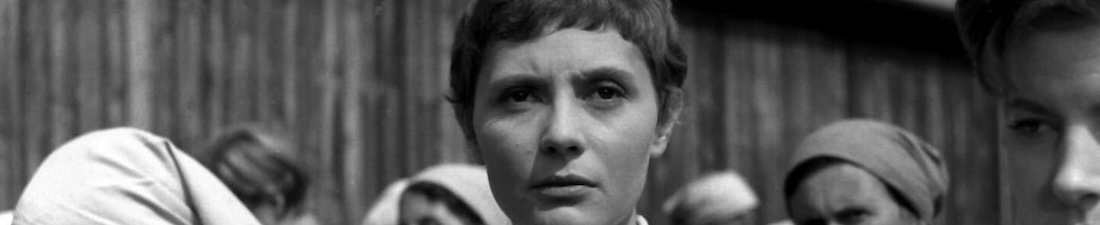
How did I not know about this?


The Polish film Passenger begins when a cruise passenger named Liza Kretschmer thinks she recognizes another woman on the ship from their time in the concentration camp. Apparently, she has never told her husband what she did during . . . certain years . . . and, she says, “Perhaps it’s best if you hear it from me at last.”
What a story that will be.

Country: Poland.
Running time: 62 minutes.
Director: Witold Lesiewicz, Andrzej Munk.
Writer: Andrzej Munk, Zofia Posmysz-Piasecka.
Based on: the play Passenger from Cabin Number 45, by Zofia Posmysz-Piasecka.
Cast includes: Aleksandra Śląska, Anna Ciepielewska.
Links: Wikipedia, IMDB
FIPRESCI Prize
Keywords: auschwitz, concentration camp, holocaust, nazis.
Set in era: historical.
Is it well known? little.
How did I see it? home.
Had I seen this before? never before.
“I wasn’t a prisoner — I was an overseer,” she tells her husband, which is an interesting choice of words.
“Don’t look at me like that — I never hurt anyone. I had nothing to do with the prisoners, only their things,” she reassures him, as we are shown a storeroom with racks of coats and baskets overflowing with personal items like combs.
Okay, so this is going to be the story of a woman with a relatively innocent role on the sidelines of one of the concentration camps, and what she saw there. But let’s freeze everything right there for a second because there is a freaky complication before we even get to that story.
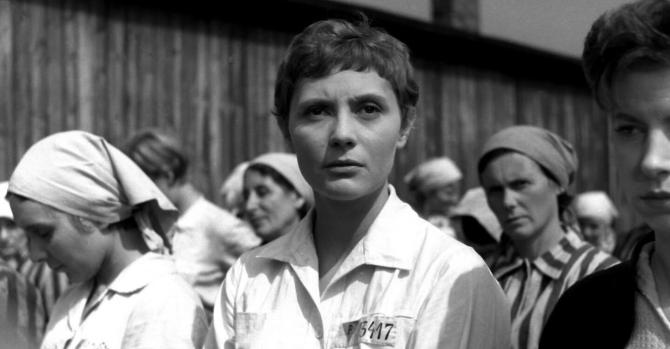
The freaky complication is that the director of this movie, Andrzej Munk, who incidentally was a Polish Jew who was in the Warsaw Uprising and survived the Holocaust by assuming fake identities, died in a car accident in the middle of the production, and that’s the first thing they tell us via voiceover.
“We have no intention of adding what he had no time to say himself,” the voice declares. “We merely wish to present what was filmed, with all the gaps and reticence, in order to grasp whatever is alive and significant.”
So the film was left unfinished, and everything I’ve described above is spoken over a series of still images, suggesting what the film would have been if completed. However . . . however . . . then we flash back to the two women’s story in the actual camp, which is the part that is a proper film, completed before Munk’s death.
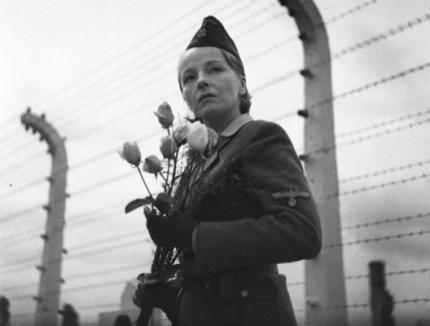
And when I say “the actual camp,” it is the actual camp. At first I thought, that looks just like the front of Auschwitz. Then as the story continued, I thought, they really created something that would look like the real thing, not a film set. Then I thought, no, it can’t be.
It is. I am stunned.
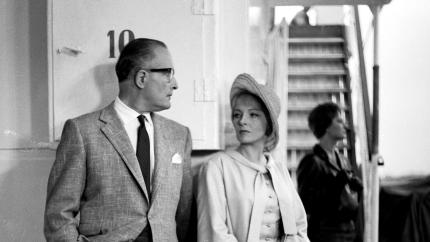
Let’s talk just a little bit more about the story. We go back to the beginning, as the very pulled-together blonde Liza arrives for her job at Auschwitz. She’s going to need an assistant, so she reviews the rows of female prisoners to pick out the one. I find myself drawn into this choice in a way that is completely uncomfortable, thinking, oh, that’s a good one; no, that one’s too old; that one’s too weak. There’s another good one; save that one. How little would it have taken for me, put in the same situation, to participate in this machinery?
Her choice lands on Marta. For not the only time in this movie, Liza congratulates herself for saving Marta’s life. Without going too much farther into it, this becomes a masterful portrayal of someone who has constructed one story she can live with and has a thoroughly different story that’s the truth. Imagine the number of people who were carrying around a secret past like that in 1963.
If you get a chance to see this movie (and it isn’t easy to), you are going to see a lot that is stunningly real about Auschwitz, starting with the fact that you are really living, vicariously, in Auschwitz. In fact, from what I gather from the DVD extra, the cast actually did live in Auschwitz for a month while filming the movie.
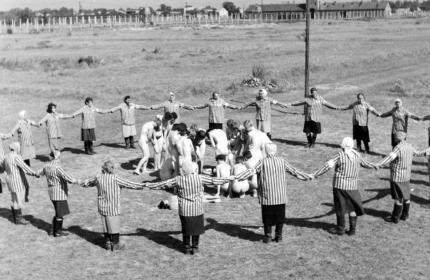
This means three things. 1. Just the fabric of life is not fake — it’s exactly as it was. The buildings, the bunks, the guard posts, the fences, the day-to-day treatment — every single thing. (Incidentally, the facilities are not worse than descriptions we’ve received of today’s concentration camps in America.) 2. Certain atrocities are suggested and others are shown, in the exact facility and the exact manner in which they were done in the Holocaust. And 3. A lot of what we see is the daily functioning of the place, which is part of the message. People, just like Liza, had to make the whole operation run. Nothing is done to an extreme or for shock value, but the realism of what you see is simply amazing.
I would never have heard of this movie if I hadn’t started Other People’s Favorite Movies and if it hadn’t received the FIPRESCI Prize at Cannes in 1964. That makes it somebody’s favorite movie, so I went and found it.* Auschwitz was opened as a museum and memorial in 1947, very soon after the end of the war, and in general it does not allow commercial filming inside, so it’s fair to say there never has been and never will be another film like this one.
I feel very critical of many films about the Holocaust — if you tell a story badly, that’s something I get upset by. A rule of thumb is, if the film has won an Oscar, it is probably overhyped and I probably don’t care for it.
On the other hand, there are some outstanding films on the subject. This is right around the top. I simply can’t believe I had never heard of Passenger before now.
Obviously, one reason it has been left in obscurity is that they decided not to finish it. That was a mistake. How can you, who were literally working with him in every capacity, say, “We can never achieve the director’s intention,” instead of going and achieving the director’s intention? The film is only half of what it should be because it is literally only half of what it was supposed to be.
Even with that, the film must not be missed. Even as it will continue to, almost entirely, be missed.
Notes
1. * I found the film at Scarecrow Video in Seattle, which does rent-by-mail and seems to be a great film library of last resort because of its truly extraordinary collection. It costs a bit of money for rental+postage, but this won’t be the last time I rely on them.
2. I have a list of my own top ~250 films of all time, which will eventually make it onto this site. But it’s a work in progress! I’m still discovering movies that I absolutely have to add to the list, and this is one of them.
3. The DVD comes with a long extra feature about the movie. Actress Anna Ciepielewska recalls about the director, Munk:
"He was cruel. He was laughing at me and I was crying. I didn’t know what he was trying to achieve. Those were his methods. He was starving me — not so I would lose weight but so I could experience hunger."
Having spent a month within its walls, she talks about something that might not have been your first thought:
"A very unsettling thing in Auschwitz was the noise of the wires [the barbed-wire fencing]. They were moved by wind or the changing weather. I remember very well when we arrived at Auschwitz and heard the wires for the first time. It was unbearable."
A former Auschwitz prisoner (who is unidentified but I think was also part of the production) talks about the same thing:
"These wires made a terrible impression on me. There is no exit. One is most frightened in a situation from which there is no escape. The wires were electrified — we knew that. When I saw it for the first time, I thought it was — I wasn’t even thinking about what was happening inside the buildings."
Country: Poland.
Running time: 62 minutes.
Director: Witold Lesiewicz, Andrzej Munk.
Writer: Andrzej Munk, Zofia Posmysz-Piasecka.
Based on: the play Passenger from Cabin Number 45, by Zofia Posmysz-Piasecka.
Cast includes: Aleksandra Śląska, Anna Ciepielewska.
Links: Wikipedia, IMDB
FIPRESCI Prize
Keywords: auschwitz, concentration camp, holocaust, nazis.
Set in era: historical.
Is it well known? little.
How did I see it? home.
Had I seen this before? never before.