
I’m Tryon my best


There’s a line from All In The Family that I’ve apparently remembered for 50 years. Edith and a very annoyed Archie come home from the movies and Edith says, "I thought it was a religious picture. Cardinal Knowledge."
The Cardinal is also supposed to be a religious picture about a priest so pious and right-headed that his path to cardinal is assured. But is it? If they wanted to make Catholic viewers happy, they mostly succeeded with this film. But if you wanted to make the Catholic Church look terrible, you could make almost the same film and succeed. Stick with me.
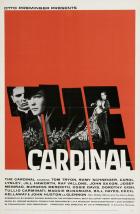
Country: United States.
Running time: 175 minutes.
Director: Otto Preminger.
Writer: Robert Dozier.
Based on: the novel The Cardinal by Henry Morton Robinson.
Cast includes: Tom Tryon, Romy Schneider, Carol Lynley, Jill Haworth, Raf Vallone, Josef Meinrad, Burgess Meredith, Ossie Davis, John Saxon, Dorothy Gish, John Huston.
Links: Wikipedia, IMDB
#18, US box office
Academy Awards:
Supporting actor (nominated)
Cinematography (nominated)
Editing (nominated)
Director (nominated)
Golden Globes:
Best drama (winner)
Actor drama (nominated)
Actress drama (nominated)
Director (nominated)
Supporting actor (winner)
Keywords: abortion, catholic, nazis, priest.
Is it well known? less.
How did I see it? home.
Had I seen this before? recent years on video.
Our young priest’s story starts inauspiciously — but star-studdedly — as Father Stephen Fermoyle (Tom Tryon) is sent by his superior in the Boston archdiocese (John Huston) to a remote, poor and rural parish where the resident priest (Burgess Meredith) is on the verge of death and the people are in great need. He is perhaps meant to disappear there, or maybe just have his devotion tested.
Will this be the end of the road for our hero? Here’s the thing — who cares? He isn’t Odysseus — he’s a servant of Christ, which means he’s a servant of those in the most need, wherever they are. Jesus said so himself. But we’ve already been shown from scene 1 what great promise Stephen has as a theological thinker and that some in Rome have their eyes on him and expect big things. That makes this rural pit stop just a rather unfortunate momentary setback on his road to greatness.
So the movie has us invested in Father Stephen’s rise instead of his service. Hmmm. A little weird. That’s a dramatic priority, not a religious one. And this will be true of the whole movie — it’s a story built around a pious religious man but really constructed for the drama.
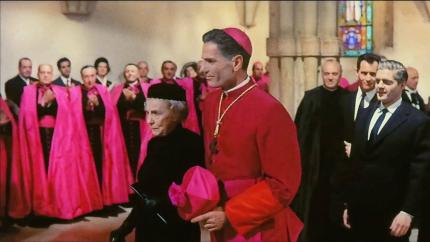
Father Stephen goes a lot of places on his journey, but some of his first crises occur close to home. You see, his sister Mona has decided to commit the sin of marrying a Jew. No, Stephen helpfully reminds her. As a compromise, it is decided that the Jew will convert, although he kind of doesn’t want to, and then he doesn’t, and then he goes off to the war, and you know, the soap opera continues.
This whole screw-the-Jew business sits pretty badly with me. (Thanks, Jewish director Otto Preminger!) Although maybe I should acknowledge that it might go down that way in a real Catholic family in 1963 when you’ve got a literally holier-than-thou big brother and a little sister who, ridiculously, feels like she should make her own life decisions.
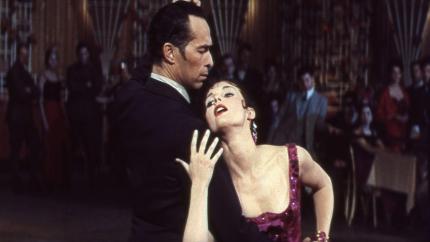
Down the road, this leads to alienated Mona going down a bad path, getting involved with ethnic nightclub singers, getting pregnant, and ultimately lying minimally conscious in a hospital bed with a life-threatening pregnancy. The only person who can make a decision for her is her brother, who is seen agonizing over this moral dilemma. But the church’s teaching is clear — you can’t kill that precious little baby. Your sister (the nightclub-goer and race-mixer) has to die. Sorry not sorry.
Most importantly, the audience is supposed to appreciate HIS sacrifice when he has to sacrifice his sister for a principle. It’s pretty obvious that his sister wouldn’t have made the same choice, but luckily, she was a vegetable at the time. Anyway, dames, am I right?
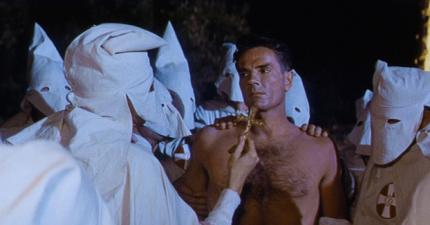
Long story short, Stephen is shaken a bit in his faith (because of course we’re focused on how he feels about what just happened) and moves on from Boston to Vienna, where he discovers a profound (but perhaps safely platonic?) affection for a woman. Then, having been tested, he dumps her, goes back to the priesthood and gets in good again with the Vatican, which sends him to the US south for a minute, where he’s beaten by Klansmen. And then the church sends him back to Vienna to see what’s up with the Nazis. Oh, and finally he gets to be installed as a cardinal. Yay! Happy ending!
You could say this is an intense human drama, and I think for a lot of 1963 Catholics it probably was. (The movie was #18 at the box office, right after The Birds and above Hud.) But it’s also very Forrest Gump. They took the IDEA of a priest and hung a bunch of other historical elements on that to make the story they wanted with lots of bang-up events in it. It’s a bit of an adventure movie but in the Catholic idiom.
The movie was based on a popular and controversial 1950 novel by Henry Morton Robinson, with a screenplay by Robert Dozier (who is not well enough known to have a Wikipedia page?), but actually nobody was happy with the script so it was rewritten by Gore Vidal and Ring Lardner Jr.
“I don’t know whether Otto realized that both Gore and I were atheists,” Lardner wrote in his memoir. “Another thing we had in common, and which we jointly communicated to Otto, was our verdict that he had fallen into the habit of buying the movie rights to some of the worst-written best sellers on the market.”
By all accounts, Preminger terrorized his star, Tom Tryon. Having screen-tested the largely unknown Robert Redford and Warren Beatty, Preminger had a successful audition with Tryon in which, according to the actor: “He pulled things out of me. He made suggestions. He never raised his voice.” A number of people warned the actor against working with the tyrannical director, but he dismissed their concern: “No, you don’t understand. I have a rapport with Otto and we’re going to get along just fine.”
Preminger’s cruelty began on the first day of shooting. As Tryon tells it:
"It was 40 miles away from my hometown of Hartford, and all of my family were there. Friends had come from miles around and we were out in the middle of the street when, at eleven that morning, Otto fired me. He fired me because poor dear Cecil Kellaway, with whom I had a long tracking shot, kept going up on his lines. Well, he didn’t hit Cecil, he hit me. After I said, ‘Otto, I know my lines,’ he told me I was through. I went down to the basement of the church where we were shooting and changed my clothes. The assistant director came down, and asked why I wasn’t on the set. I said I’d been fired and I was leaving. I wish to hell I had. Then Preminger came down in a rage. ‘What do you think you’re doing?’ ‘Well, you fired me, Otto, and I’m going.’ ‘Don’t be silly,’ he said, as if it had all been a joke. Well, it wasn’t a joke. I had to go back up to start filming again. The first day wasn’t over yet, I had started to shake, and for the entire filming I never stopped."
Co-star Carol Lynley confirms this:
“When Otto would shout, Tom just rolled over and became like a small boy being whipped. He would get the shakes. In one scene, a cup and saucer had to be taped to his hands.”
Of course, she says, he didn’t dare treat accomplished Italian actor Raf Vallone or the famous director John Huston — who probably outranked him among Great Directors — with such abuse. “He knew they’d yell right back and match him in volume,” she says. Bullies are so predictable.
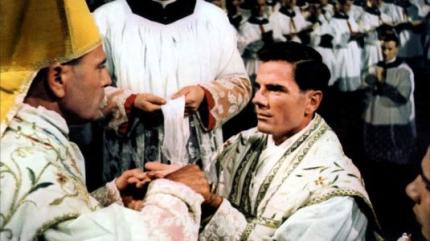
Still, Tryon’s performance is very upright and solid, as I think it should be. One can only imagine Redford or Beatty’s dashing, youthful, interesting faces and how wrong they would have been for this cardinal-in-the-making who has to represent the unyielding will of God. Tryon’s main emotion — which we now know was bearing up under terror of his director — is non-emotion. He comes across as supremely dignified, which is probably just right.
But let’s look behind that sharp, stoic face for a minute. As it does for Tryon the actor, it hides a deeper, messed-up truth for Father Stephen the character. It’s never discussed in this way, but Stephen is a prisoner of his own ideology.
I think of a scene that comes after someone in Stephen’s Viennese circle who has been in the anti-Nazi resistance kills himself to avoid falling into the Nazi’s hands. After he is buried, Stephen’s former paramour asks, “You don’t think what he did was right, do you?” And he answers, “Nothing ever can justify suicide. But some cases are easier to understand. The mental condition of people who feel persecuted becomes distorted, and nothing they do is understandable to the normal mind.”
This is remarkable. The suicide happened in front of their eyes, and all they can think about is doctrine and not the reality of the Nazi holocaust and its resistance — and this is with 20 to 30 years’ hindsight by the time the movie is made. It’s the sister’s story all over again. The rules say no Jews, the rules say no abortion, the rules say no suicide — if you had a normal mind you’d understand.
Stephen is made a hero for thinking this way — but he’s the opposite. I think they inadvertently made a movie about — I hesitate to say a psychopath, but a stunted personality who only understands rigid obedience and doesn’t understand the burden of power or its human cost. He approaches his calling (unlike what we’re seeing from the church’s leadership today) without compassion. It would take only the slightest change in tone to make this the most anti-Catholic film imaginable.
Notes
1. Background details in this article are from Otto Preminger: The Man Who Would Be King by Foster Hirsch.
2. A very interesting coda to the life of Tom Tryon, quoting from Wikipedia:
During the 1970s, he was in a romantic relationship with Clive Clerk, one of the original cast members of A Chorus Line and an interior designer who decorated Tryon’s apartment on Central Park West in New York City, which was featured in Architectural Digest.[citation needed] From 1973 to 1977, Tryon was in a relationship with porn actor Casey Donovan.
Tryon died on September 4, 1991, at the age of 65 in Los Angeles, California. The announced cause of death was stomach cancer. Tryon’s literary executor, C. Thomas Holloway, later stated Tryon’s illness was related to his HIV-positive status. Tryon asked to keep this information private. When Tryon’s lover Clive Clerk explained, “Tom didn’t want his readers or his relatives to know,” Holloway disapproved, writing, “I see it as Tom’s selfish silence helped the Dark Ages [of public acceptance of HIV/AIDS] continue into the millennium.”
3. A friend also notes that Tryon went on to write a best-selling novel called The Other, which was made into a 1972 film. (My friend recommends both! Maybe I’ll get to them when I do the year 1972!)
4. The book was thought to be based on New York’s Cardinal Francis Spellman, who is said to have resisted the movie adaptation, partly because it depicted him as having a sister pregnant out of wedlock, which he did not.
Despite Spellman’s influence, the Vatican eventually appointed as liaison to the production Joseph Ratzinger, who went on decades later to become Pope Benedict XVI.
The conversation
To appreciate the showman’s achievement in The Cardinal it’s necessary first to take a close look at his leading man, who in all the ways that count is exactly the right actor for a Preminger epic. Stephen Fermoyle is not the monochromatic character that Tryon complained about, but neither is the evolving drama of Stephen’s faith overcoming his doubt Preminger’s primary concern. The filmmaker’s focus, rather, is to present, in a pageantlike way, the social and political issues — abortion, fake miracles, interfaith marriage, racism, fascism, power struggles within the church — against which the character’s spiritual history is enacted. As in Exodus, Preminger is engaged more by the narrative’s panoramic backgrounds than by the travails of its leading character. Tryon’s smooth minimalism helps Preminger to make the kind of objective epic that is his forte, whereas a ‘brilliant’ or overinventive actor playing Stephen would have interfered with the filmmaker’s intention.
Foster Hirsch, in Otto Preminger: The Man Who Would Be King
Reaction within the Vatican as reported by Preminger’s wife, Hope:
On Friday and Saturday during his visit Preminger screened his film for the cardinals of the Roman Curia of the church and the bishops attending the Ecumenical Council. “Because there is no theater at the vatican, we screened it at the College of Cardinals, where everyone sat on wooden benches,” Hope said. “I was the only woman present. The audience loved it — they did not feel the film was at all anti-Catholic.” Mr. and Mrs. Preminger were granted a private audience with Pope Paul VI, “a very cold man, but very learned,” Hope noted.
Foster Hirsch, Otto Preminger: The Man Who Would Be King
Two looks at the movie from The New York Times in 1963:
It looks as though Otto Preminger has missed the boat again in attempting to make a motion picture on a vital contemporary theme. His new film, “The Cardinal,” which opened last week at the DeMille, makes every pretense of being a true reflection of the Roman Catholic Church as revealed in the meaningful experiences of a young American priest. But it is no more a credible exposure of the spiritual and temporal nature of the church — or, indeed, of a Catholic prelate who might rise to the rank of Cardinal than “Exodus” was a true exposure of the birth of the State of Israel or “Advise and Consent” a true exposure of the United States Senate at work. Somehow, the same kind of fiddling with reality is evident in this film as was evident in those two previous pictures that Mr. Preminger did and I simply cannot understand why he has allowed this to occur.
Bosley Crowther, How to become a cardinal without trying, The New York Times, 1963
It strikes me that Otto Preminger sets his sights on the wrong Cardinal in his new film, “The Cardinal,” which opened last night at the DeMille.
To me, the most interesting prelate in this three-hour-long color film that offers a panorama of incidents in the life of an American priest is not the stiff-backed young hero who rises in 22 years from the rank of lowly curate to that of a prince of the Roman Catholic Church. It is the craggy old Cardinal of Boston to whom the young priest is briefly exposed and whose rugged Irish personality is the most authentic and appealing in the film.
It is this old boy, played by John Huston—the same John Huston who is one of this country’s, top film directors—who arrests and fascinates me. He’s the one who reveals in just a few scenes toughness, authority, political acumen, compassion and a fine philosophical turn of mind.
Bosley Crowther, "Episodes of a Man of the Cloth:'The Cardinal’ Opens at the DeMille The Cast, The New York Times, 1963
A writer in one of the country’s leading magazines covering Catholic issues HATED the movie when it came out:
The hero (Tom Tryon) is not a man with an abiding moral and intellectual commitment to serve God in a special way. He is a secular, soap-opera version of Everyman, given to flabby emotional thinking; harboring belated doubts about his vocation that would, in actuality, have caused him to be dropped from the seminary; expressing no religious or ethical convictions except “safe” and popular ones; and buffeted up the ladder of ecclesiastical success by coincidences and happenstances not remotely connected with aptitude or religious dedication. In short, for screen purposes Preminger has made over the Catholic Church to conform to the image of amorphous tolerance and flabby do-goodism that he judges to be most acceptable and emotionally appealing to the mass audience.
Moira Walsh, America magazine, 1964 (not available online)
But a current-day Catholic blogger loves it:
Faithful, loving, firm, and strong — this is what every person desires in a father and what every parishioner desires from their local pastor. Look no further than Stephen Fermoyle, the main character of The Cardinal (1963). In a world where subsets of the Catholic faithful have fallen into some version of the “Barney-the-Dinosaur-esque” prosperity gospel, The Cardinal offers a glimpse into what our Great-Grandparents’ Catholicism may have looked like. Catholics living in a post-Christian world hunger for a porthole into the past. The film encapsulated this astoundingly.
H.B. Marcel, BeholdTheFaith.com, 2024
Country: United States.
Running time: 175 minutes.
Director: Otto Preminger.
Writer: Robert Dozier.
Based on: the novel The Cardinal by Henry Morton Robinson.
Cast includes: Tom Tryon, Romy Schneider, Carol Lynley, Jill Haworth, Raf Vallone, Josef Meinrad, Burgess Meredith, Ossie Davis, John Saxon, Dorothy Gish, John Huston.
Links: Wikipedia, IMDB
#18, US box office
Academy Awards:
Supporting actor (nominated)
Cinematography (nominated)
Editing (nominated)
Director (nominated)
Golden Globes:
Best drama (winner)
Actor drama (nominated)
Actress drama (nominated)
Director (nominated)
Supporting actor (winner)
Keywords: abortion, catholic, nazis, priest.
Is it well known? less.
How did I see it? home.
Had I seen this before? recent years on video.