
So much winning


How The West Was Won opens (as it will close) with flyover vistas of this great land of ours, topped by a voiceover oration by Spencer Tracy meant to inspire us about America and the multi-part epic of which we are about to partake:
“This land has a name today and is marked on maps. But the names and the marks and the land all had to be won. Won from nature and from primitive man.”
Right, from primitive man. So that, you know, superior American men could live there instead. This sounded good to people’s ears in 1962-63 and I think you can already see what’s wrong right from the start. But let’s get back to that in a minute, because first I want to share with you my absolute favorite thing in any movie of 1963. We see a rocky mountainside onto which a lone Jimmy Stewart appears, at first very small, and rides his horse steadily toward the camera. Spencer Tracy continues:
“Five generations ago, a mere 125 years back, this land was known only as The West. Known only to a handful of white men, lonely trappers wandering its vastness in search of beaver.”
I’d be in search of beaver too. It was hard to find round those parts.
(That’s really the only reason I care about posting this review, so we’re kind of done. But read on if you wish.)
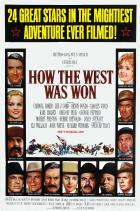
Country: United States.
Running time: 164 minutes.
Director: Henry Hathaway, John Ford, George Marshall.
Writer: James R. Webb.
Cast includes: Carroll Baker, Lee J. Cobb, Henry Fonda, Karl Malden, Gregory Peck, George Peppard, Robert Preston, Debbie Reynolds, James Stewart, Eli Wallach, John Wayne, Richard Widmark, Walter Brennan, Agnes Moorhead, Harry Morgan, Spencer Tracy, Thelma Ritter, Russ Tamblyn.
Links: Wikipedia, IMDB
#2, US box office
Academy Awards:
Original screenplay (winner)
Cinematography (nominated)
Editing (winner)
Best picture (nominated)
Set in era: historical.
Is it well known? well known.
How did I see it? home.
Had I seen this before? never before.
How The West Was Won is an ambitious epic, grandly conceived and extravagantly made, with everything you’d want to please a crowd — adventure, romance, war, treachery, cowboys and Indians, a train robbery, a shootout, some musical numbers, all in spectacular Cinerama. It was #2 at the box office in 1963 behind the year’s other dazzling spectacle, Cleopatra.
Its subject is one family’s journey from having little more than grit and dreams in the east (patriarch: Karl Malden) to, two generations later, having created different forms of pride and prosperity for themselves in the west (patriarch: George Peppard). Three different directors and a large cast including many recognizable actors in numerous locations across the country make this a reality. It’s impressive.
I could get into the details, but why? If you’re MAGA, this movie is your sacred mythology to a T. You could still enjoy it! It’s very down-homey and John Wayne-y. (He’s one of the many stars.) If you’re a more reality-based American, you already realize that going out and “winning” the West didn’t just happen fair-and-square like winning a bet or a baseball game. It was a conquest. The whole framing covers up a lot of history.
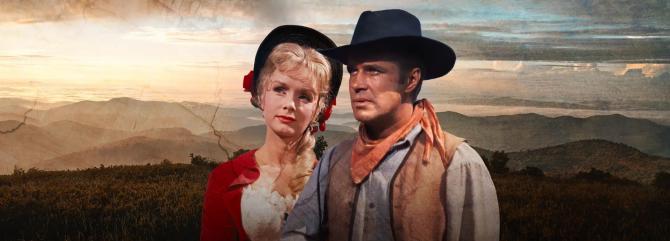
I’m not going to get boring and try to expound on centuries of history here. I’ll just mention a very worthwhile book called The End of the Myth (2019) by Greg Grandin, which looks at the changing geography and mentality of the American frontier. My #1 takeaway from the book is this: We learned American history as the irrepressible growth of the United States from small to large like a painting being created on a blank canvas, and I think small-to-large is what it still was in my mind until I read the book. But of course the reality is that our history is the region-by-region remaking of a non-white continent that was Native American and Mexican into a complex but white-dominated one. That would be more accurate. The West was always there; it was just changed in complexion.
This movie is that story, sometimes celebrated, its flaws sometimes acknowledged, but mostly covered over with extraordinary pictures.
That’s really enough said about HTWWW — you can practically review it in your head from what I’ve told you. But there are two more things I want to point out.
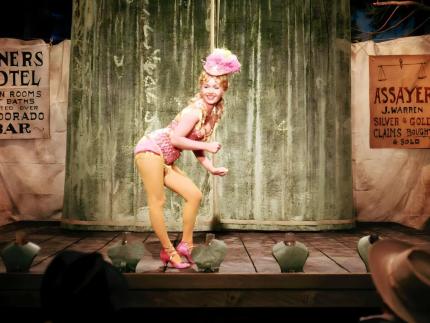
One thing stands out to me because it’s such an interesting part of the American psyche. The Prescott-Rawlings family, in their virtuous quest to spread the goodness of America all over this great land, are waylayed by pirates, attacked by Indians, cheated by swindlers, and beset by bandits.
This takes advantage of, and then feeds, that corner of the American brain that is convinced that everybody’s going to get you. The year after this movie, Richard Hofstadter published The Paranoid Style in American Politics, and we can trace stranger-fear all the way to the present, when we have a president who clawed his way to office on stories that Mexicans are rapists and Haitians are eating your pets. That’s why, from the time of this movie to now, Americans had to move out to their safe suburban getaways and all buy guns, like the intrepid frontiersmen who are our stock. Our culture is built on being scared of everything. The good people needing to be scared of the bad people everywhere all the time — it’s a running theme of this movie. And America.
I looked many places for Native American reviews or reactions to this movie, and found none. (I found a number of good books, though, that will make future appearances in this blog.) One thing I did find is this highly pertinent quote from a Sioux leader named Standing Bear (I think this is his correct biography):
The white man does not understand the Indian for the reason that he does not understand America. He is too far removed from its formative processes. The roots of the tree of his life have not yet grasped the rock and soil. The white man is still troubled with primitive fears; he still has in his consciousness the perils of this frontier continent, some of its fastnesses not yet having yielded to his questing footsteps and inquiring eyes. He shudders still with the memory of the loss of his forefathers upon its scorching deserts and forbidding mountain-slopes. The man from Europe is still a foreigner and an alien. And he still hates the man who questioned his path across the continent. But in the Indian the spirit of the land is still vested; it will be until other men are able to divine and meet its rhythm.quoted in They Have Not Spoken: American Indians in Film, Dan Georgakas
This is exactly the error in perspective of How the West Was Won. The movie is the story of how the white man overcame impediments to subjugate the land and repel the people who were there, pausing to learn nothing and adapt in no way. That’s the movie.
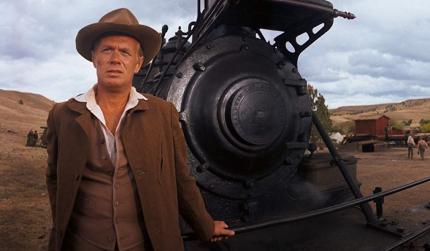
One other thing that bugs me about HTWWW is what I’m sure many will consider one of its strengths — those stunning western vistas. I grew up in the west, and I’m going to tell you a secret. Are you ready? NOBODY LIVES IN MONUMENT VALLEY.
(Fact check: That’s not quite true — the Monument Valley region lies in Navajo and Ute lands and fewer than a thousand people live there. The point being . . .)
The camera loves Monument Valley but that doesn’t mean that the family in the movie ranched in it. The family in The Searchers also didn’t ranch in it. The movie seeks out the most spectacular locations possible, which are eye-pleasing at first but the cherry-picking is just ridiculous to me personally. It’s as if the Corleone family lived in the Empire State Building and then moved to the Statue of Liberty.
Like so many other myths of the old westerns, the landscape is blatantly untrue — which is something the audience has learned to demand. I’ve seen critics complain that movies set in the west didn’t look scenic enough because they didn’t show enough of the breathtaking landscapes that the critics expected to see. Listen, that isn’t who we are — we’re people in places just like everyone else. It’s amazing how the west is spun.
Notes
1. Was I ever surprised to listen to the closing theme of the movie and hear a stirring chorus sing the line “Hell-bent for leather!” which (if you’re like me) we all know better as the title of a 1978 Judas Priest song. Apparently the expression goes back to the late 1800s and early 1900s, referring to riding a horse as hard as possible in your leather saddle. It appears in other songs including the Rawhide theme. (See DailyWritingTips.com.)
2. A quick explanation of Cinerama: Films like HTWWW were filmed with three cameras for an extra-wide image, then projected with three projectors onto screens that curved around the audience for a more encompassing experience. Other notable films that were screened (but not necessarily filmed) in Cinerama included This Is Cinerama, It’s a Mad, Mad, Mad, Mad World, Battle of the Bulge, and The Greatest Show on Earth. A detailed explanation is here at UCLA.edu.
3. The booklet accompanying the blu-ray includes tons of impressive facts about the production:
• Bit players and extras appearing in the film totaled 12,617. There were 630 horses, 150 mules and 50 head of oxen, tended by 203 wranglers. From reservations in South Dakota, Colorado and Utah, 350 Indians were recruited. There were 107 Conestoga and trail wagons.
• At the height of production, the pool of studio vehicles, continually on the move over transcontinental highways for months on end, numbered 71, including 55-foot, 18-wheeled semitrailer trucks with 60,000-pound capacity, 50-foot vans, two-ton vans, four-wheel drive equipment, caterpillars, buses, station wagons and passenger cars.
• It required more than two months for wranglers to corral the 2,000 buffalo seen in the film’s spectacular stampede scene, filmed in South Dakota.
• More than 5,000 pairs of period shoes [hehe, “period shoes.” Sorry. Carry on.] and Indian moccasins were hand made to be worn by characters in How the West Was Won.
• Thousands of yards of homespun material had to be ordered from ancient looms in India for the special costumes. Cinerama cameras are se critical, they show up as false any attempts to substitute modern fabrics with machine stitching. So all costumes had to be sewn by hand.
• Five famous Native American tribes are represented among the Indian personnel of the film — the Brules, Oglallas and Minnecanjous of the Sioux nation, and the Arapahoes and Cheyennes.
• Among the real Native Americans in the film were Chief Weasel of the Oglalla tribe, a survivor of the Wounded Knee Massacre who spent eight years with the Buffalo Bill Cody Show; Red Cloud, who helped wipe out Custer’s forces at the Little Big Horn; and Ben Black Elk, son of a medicine man.
• Twenty thousand pounds of hay and 1,000 pounds of grain were needed daily to feed the 600 horses used in the production. Thousands more pounds of feed were needed for the buffalo and other stock used in the film.
The conversation
• It’s funny that all three leading reviewers I could find from 1963 not only panned the very popular movie in similar terms but all wanted to rename it:
Don’t look for any enlightenment as to the conquest of the American frontier in “How the West Was Won,” showing two-a-day at Loew’s Cinerama Theater. Everything in this latest feature on the king-size Cinerama screen is a dutiful duplication of something you’ve already seen in anywhere from one to a thousand Western movies in the past 60 years. . . . All in all, an excellent opportunity to do a real historical drama of the West was wasted in this Hollywood-cured “epic.” It should be called “How the West Was Done—to Death."
‘How the West Was Won,’ Familiar Saga, The New York Times, 1963
THE latest Cinerama spectacle, “How the West Was Won,” might have been more accurately entitled “How the West Was Gol-Durned Near Lost,” because it turns out to be a very long, very noisy, and very highly colored account of a series of preposterous blunders on the part of our sweaty, hard-breathing ancestors. Had the real pioneers been anything like as dim-witted as the figures depicted here, the United States would still lie huddled well this side of the Appalachian barrier, and the deer and the antelope would be roaming the tussocky underbrush of what are now Chicago, St. Louis, and Salt Lake City.
Brendan Gill, Bunglers, The New Yorker, 1963
"How the West Was Lost” would be a more appropriate title for this dud epic, since, as conceived by the writer, James R. Webb, the pioneers seem to be dimwitted bunglers who can’t do anything right.
Pauline Kael (unconfirmed quote from original review)
A modern-era blogger gets it right (for a modern audience) (and with spoilers!).
In How The West Was Won the good guys are all-good, the bad guys are all-bad, and good always triumphs over bad. The film presents a most naive, sugar-coated and earnest view of the old world. Despite the sophomoric storytelling, some reasonable highlights do emerge: the Civil War scenes are impressively staged and the unleashing of a buffalo stampede as a weapon against the rail companies is memorable. The stunt work during the final train heist also deserves recognition. . . .
How The West Was Won fails to resonate, and has a ghastly ending that suddenly jumps to the present and trumpets American freeways, interchanges and concrete jungles as the most prominent signs of triumph. The times have indeed changed.
Ace Black Blog, 2010
Country: United States.
Running time: 164 minutes.
Director: Henry Hathaway, John Ford, George Marshall.
Writer: James R. Webb.
Cast includes: Carroll Baker, Lee J. Cobb, Henry Fonda, Karl Malden, Gregory Peck, George Peppard, Robert Preston, Debbie Reynolds, James Stewart, Eli Wallach, John Wayne, Richard Widmark, Walter Brennan, Agnes Moorhead, Harry Morgan, Spencer Tracy, Thelma Ritter, Russ Tamblyn.
Links: Wikipedia, IMDB
#2, US box office
Academy Awards:
Original screenplay (winner)
Cinematography (nominated)
Editing (winner)
Best picture (nominated)
Set in era: historical.
Is it well known? well known.
How did I see it? home.
Had I seen this before? never before.