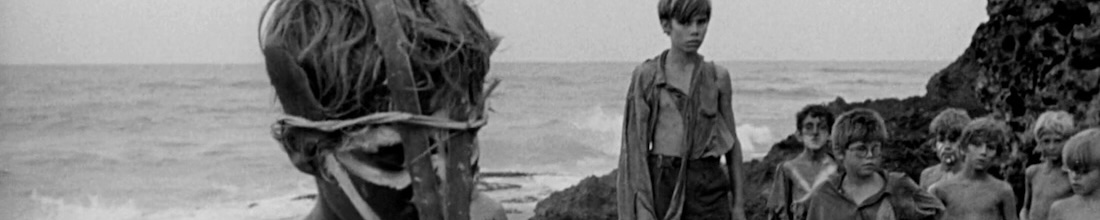
Isle be damned


I hardly need to tell most readers anything about Lord of the Flies. The novel was assigned reading for most of us in middle school or early high school — but somehow I missed it. So — maybe unlike you — this is my first go-round with Lord of the Flies.
Which is an unusual way to experience a book that we’ve now classed as one about kids for kids, and which we put away after writing a book report on it at age 11, 12 or 13. Lord of the Flies is now a cultural shorthand for a certain idea, that left to nature, boys would revert to nature. Not people in general, just boys.
Country: United Kingdom.
Running time: 92 minutes.
Director: Peter Brook.
Writer: Peter Brook.
Based on: the novel Lord of the Flies by William Golding.
Cast includes: James Aubrey, Tom Chapin, Hugh Edwards, Tom Gaman, David Surtees, Nicholas Hammond.
Links: Wikipedia, IMDB
Keywords: castaways, island, survival, tribalism.
Set in era: contemporary.
Is it well known? well known.
How did I see it? home.
Had I seen this before? never before.
Compared to book: both are good.
Overrated? underrated.
This is a too-narrow interpretation of the parable. Does savagery not live in the adult soul as well? Do we not have two animals within all of us — isn’t that saying a cliché now? I am multiple times their age now, and on behalf of so-called adults I can say, the Lord of the Flies has no age. He is the id. He is us too.
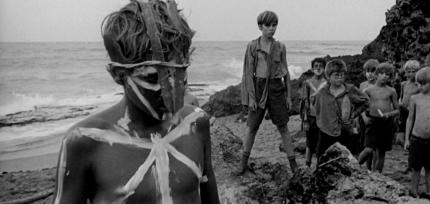
The story underlying the 1963 film will be familiar ground for many. A plane crash leaves a bunch of English schoolboys stranded on a deserted island with only their children’s wits to keep them alive. Well-raised British children’s wits, though.
“We’ve got to have rules and obey them. After all, we’re not savages — we’re English,” one little gentleman says at the beginning. “And the English are best at everything.”
(It’s funny to be writing about this movie right after Dr. No, which, as I said in that review, is fundamentally about the British entitlement to rule the globe because of their superior sophistication. Lord of the Flies takes . . . a bit different view.)
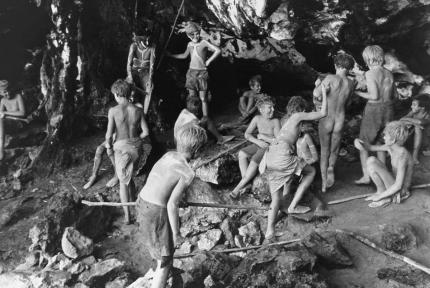
Their survival depends on cooperation — yet there is also the instinct for power and domination. The boys go down two roads simultaneously — reconstituting civilization and reverting to the law of the jungle.
I especially like the first boy that we meet, a pudgy little fellow who unfortunately gets called Piggy. While absorbing other boys’ taunts, he also represents knowledge and dignity for the whole clan, not so much through effort but because that’s who he is. As the other boys impulsively leap up to build a fire with no particular idea how, he tuts, “Just like kids. Like a crowd of kids.” He stops to clean his thick glasses and laments, “I bet it’s gone tea time.”
Piggy is the most helpless and dependent on the other boys, but he also repays their contempt with smarts, without which they would barely survive. He is the coolheaded keeper of civilization.
Meanwhile, one sub-tribe of boys establish themselves as the “hunters,” convinced that they are the essential members of the fledgling society, without whom the weaker boys would never eat and would lack protection from a menace they call “the beast.”
I’ve only just started this blog, but I already think I’m going to get tiresome making comparisons to the present day. The novel and movie are certainly prophetic. It’s not hard to see the Lord of the Flies repeated throughout history, not least in our current-day warrior-ethos America. And we didn’t just abruptly arrive here — America has been juggling civilization and brutality since . . . well, the beginning. We have two beasts inside us. At the moment, civilization is taking a beating.
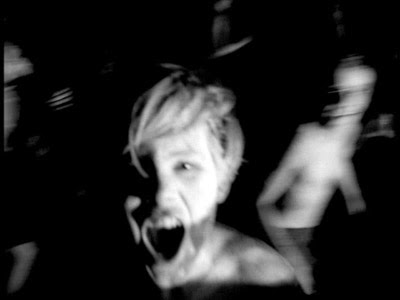
Sixty-three years later, this remains a terrific movie — and a remarkable movie achievement. The boys, only two of whom were actors, were taken to Vieques in Puerto Rico, housed in an abandoned pineapple cannery, given only a quick look at the book and minimal instructions, and turned loose to improvise much of their performance by instinct. What they did is amazing.
I think it deserves to be recognized among the greats of the British/French/Etc New Wave, and in fact near the top of the list because it’s not about louche layabouts doing nothing — it uses the New Wave ideas to intensify a story of precarity, expressed through the unpredictable actions of children. It’s a great match. The result is a fable that explores human instinct — yours and mine and our neighbors’ and our enemies’ — and still works today as strongly as ever.
Notes
1. This was funny:
When Brook showed his old friend Orson Welles the pre-cut four-hour version before his massive editing job, Welles commented: “Leave it with me with a bottle of wine and I’ll fix it.” I’d have bet on him finishing the wine, but not the film.
Rob Mackie, The Guardian, 2007
2. I picked up Lord of the Flies and read it for the first time before watching the movie. My edition has an excellent introduction by Stephen King, who talks about how he discovered the book and how it made him who he became.
Eventually – around the time John Kennedy became President, I think – we came to feel something was missing. These stories were exciting enough, but something about them was . . . off. Part of it might have been the fact that most of the stories were set in the twenties and thirties, decades before my brother David and I were born, but that was not the greater part of it. Something about those books was just wrong. The kids in them were wrong.
There was no library, but in the early 1960s the library came to us. Once a month a lumbering green van pulled up in front of our tiny school. Written on the side in large gold letters was STATE OF MAINE BOOKMOBILE. The driver-librarian was a hefty lady who liked kids almost as much as she liked books, and she was always willing to make a suggestion. One day, after I’d spent twenty minutes pulling books from the shelves in the section marked YOUNG READERS and then replacing them again, she asked me what sort of book I was looking for.
I thought about it, then asked a question – perhaps by accident, perhaps as a result of divine intervention – that unlocked the rest of my life. ‘Do you have any stories about how kids really are?’
She thought about it, then went to the section of the Bookmobile marked ADULT FICTION, and pulled out a slim hardcover volume. ‘Try this, Stevie,’ she said. ‘And if anyone asks, tell them you found it yourself. Otherwise, I might get into trouble.’ . . .
I had read adult novels before, or what passed for them (the room of water-dampened books in the Methodist parsonage was full of Hercule Poirots and Miss Marples as well as Tom Swifts), but nothing that had been written about children, for adults. I was thus unprepared for what I found between the covers of Lord of the Flies: a perfect understanding of the sort of beings I and my friends were at twelve or thirteen, untouched by the usual softsoap and deodorant. Could we be good? Yes. Could we be kind? Yes again. Could we, at the turn of a moment, become little monsters? Indeed we could. And did. At least twice a day and far more frequently on summer vacations, when we were often left to our own devices.
Stephen King, Introduction to Lord of the Flies
The conversation
The movie appears to have not been very popular with critics then or now because of its loose style and its unpolished young performers. Which is weird because (1) the movie’s amateur cast and vérité rhythms are perfect for putting the book on screen, and (2) this is EXACTLY what the critics love about the French new wave. Only this movie is better.
It is as stirring and shocking a story as has been published in a long time.But, alas, the picture made from it by the writer-director Peter Brook is a curiously flat and fragmentary visualization of the original. It is loosely and jerkily constructed, in its first and middle phases, at least, and it has a strangely perfunctory, almost listless flow of narrative in most of its scenes. The acting is woefully uneven and, except for two or three fair performances, givés unmistakable evidence of having been done by spirited amateurs.
Bosley Crowther, Agitating Fable of Wild Boys:Savagery Is Depicted in ‘Lord of the Flies', The New York Times, 1963
Here’s a good point about the use of untrained kids, part of a thorough discussion of aspects of the movie for The Criterion Contraption, a blog that until 2015 had the ambition of reviewing “every last” Criterion release.
It’s impossible to forget, watching the movie, that all of these kids are prepubescent. I also found that some scenes and images that didn’t particularly stick with me while reading the novel became iconic when captured on film. . . .
I think the single best thing about this movie is the casting, done by Terry Fay and Michael McDonald. When you’re casting children, you don’t necessarily look for someone who’s a good actor, but someone who has to do as little acting as possible to become the character you need. There’s no way for a kid to do a Charlize Theron or Robert DeNiro-style body transformation, and the psychological insights a six-year-old can have into another person are, shall we say, limited. But the kids they used were perfect, start to finish.
Matthew Dessem, The Criterion Contraption, 2005
Country: United Kingdom.
Running time: 92 minutes.
Director: Peter Brook.
Writer: Peter Brook.
Based on: the novel Lord of the Flies by William Golding.
Cast includes: James Aubrey, Tom Chapin, Hugh Edwards, Tom Gaman, David Surtees, Nicholas Hammond.
Links: Wikipedia, IMDB
Keywords: castaways, island, survival, tribalism.
Set in era: contemporary.
Is it well known? well known.
How did I see it? home.
Had I seen this before? never before.
Compared to book: both are good.
Overrated? underrated.