
“Douce” is mild


You know how sometimes two things get mixed up or connected in your head? Call me dumb, but at least now I know that Irma la Douce is not the same as Nights of Cabiria.
Irma la Douce is not a beloved and jaunty Fellini masterpiece, despite the Euro-ish title. It’s an American . . . sitcom? . . . made by Billy Wilder with Shirley MacLaine and Jack Lemmon but set in pretend Paris.
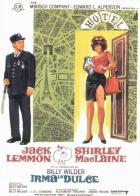
Country: United States.
Running time: 147 minutes.
Director: Billy Wilder.
Writer: Billy Wilder, I. A. L. Diamond.
Based on: the play Irma La Douce by Alexandre Breffort.
Cast includes: Jack Lemmon, Shirley MacLaine.
Links: Wikipedia, IMDB
#5, US box office
Academy Awards:
Cinematography (nominated)
Golden Globes:
Comedy or musical (nominated)
Actor musical/comedy (nominated)
Actress musical/comedy (winner)
Keywords: paris.
Is it well known? less.
How did I see it? home.
Had I seen this before? never before.
Irma is a colorful lady who sells her services alongside all the other colorful ladies on “Casanova Street,” and Nestor is an incorruptible constable who’s determined to clean up the immorality there, but . . . what’s that? Oh, it’s the spark of love interfering with what he thought was his virtue.
The plot goes a few different ways from here, and many highjinks ensue. If you want to watch the movie, you might as well know as little as possible, and if you don’t watch the movie — you’ll be just fine. There are a thousand other movies you could watch.
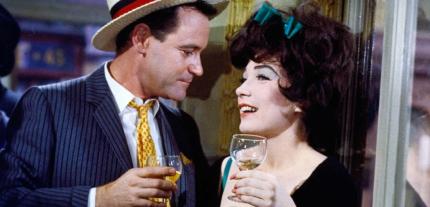
There are a few funny bits (I liked the coup de grace that solves the lovers’ dilemma!), but there are also a lot of forced dialogue, characters and plot development. Much of the movie is spent around pimps who have nothing French about them — they’re wearing American gangster suits out of Guys and Dolls, and they talk like they’re in, I don’t know, Happy Days or Grease. There is in fact not a single French person in the movie. It feels dumb a lot of the time.
There’s a moment when Nestor first comes up to Irma’s apartment (ooh la la!), and she tells him this about the place:
Irma: It used to be a studio. A painter once lived here. Poor guy. He was starving. He tried everything. Even cut his ear off.Nestor: Van Gogh?
Irma: I think his name was Schwartz.
This KIND of joke has the pattern of a Mel Brooks or Woody Allen joke — at just the time when they were getting their starts, in fact — but it misses, and they wouldn’t have missed. The artist story is disconnected to anything and the punch line is too. The sentences are clipped, which suggests the writing wasn’t thought out. Why would the artist cut his ear off to make money? If it were Van Gogh, she would have said Van Gogh used to live here. And the name “Schwartz” comes out of nowhere — it’s jarring because there is nothing Jewish about this whole production. (Apologies, Mr. Wilder.) I wonder if people in the theater laughed. Maybe.
Irma la Douce was #5 at the box office in 1963, so people enjoyed it. It’s breezy, and it must have qualified as good, rather daring entertainment in its moment. Sex is an open subject. Maybe putting us “in France” allows that — you know how les filles are in Paree! “I sleep in the nude,” Irma declares early on, and MacLaine proceeds to be nude quite a lot. Filmed tactically from the back, but still, it’s a lot in 1963.
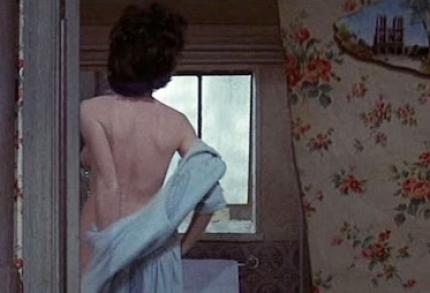
(Sources say the role was intended for Marilyn Monroe before her death, and Brigitte Bardot had an interest in the role. In either case, the movie would have been much more about ogling its naked sex symbol than getting into the swing of the story, such as it is.)
Looking back more than 60 years, it’s hard to know what expectations to have. I think movies have gotten better. The writing has gotten better. The pacing has gotten better. There was a lot of very bland entertainment then, so maybe Irma la Douce was just fine in its own time.
But I don’t know, I Love Lucy was on in the 1950s and it outdoes this by a mile. (Maybe early comedies like Lucy, Dick Van Dyke and Sid Caesar benefited from having a writing team rather than one guy* who was also the director, i.e., there was basically nobody to say no or improve his work.) In the movie world, His Girl Friday is from 1940 and is unmatched for comedy. Wilder himself had already done Sabrina (1954), Some Like It Hot (1959), and The Apartment (1960), so maybe Irma is just a miss. In fact, Wilder thought so himself:
“It didn’t work. There is always something wrong about people not speaking the language of the foreign country where the picture takes place. And you could not stand a Lemmon or a MacLaine speaking English with an accent, either. It’s false. It just does not work.”— Conversations With Wilder (Cameron Crowe)
Notes
1. * I said the movie was written by one guy to emphasize the point. Technically it was co-written by Wilder with his frequent collaborator I.A.L. Diamond. (Who, incidentally, wrote a whole explanation/apologia for the movie in the NY Times when it came out — see below.)
2. Funny thing, nearly every review I looked up also quotes the “Van Gogh” line as one of this movie’s clunkers. I guess the whole world agrees.
3. Keep an eye out for walk-ons by a young Bill Bixby and James Caan!
The conversation
“Abominable, inexplicably popular sex farce.”
Capsule review by Pauline Kael
(I can’t confirm the authenticity of this quote, but the internet doesn’t lie.)
“If, despite its deplorable start, anything attractive and amusing happens in the picture, it is because Jack Lemmon and Shirley MacLaine take over the proceedings and almost succeed in purging them of squalor. Their American faces and American voices betray Mr. Wilder’s worst intentions; a couple of vivid and gifted comics, in a vehicle totally unsuited to them, manage to justify themselves and it by failing to embody their assigned characters.”
Wrong turns
Brendan Gill, The New Yorker, June 8, 1963
“Who would have dreamed that Billy Wilder could make a bright and yet acceptable film out of the Gallic naughtiness and mischief of the stage show “Irma la Douce”? Not I, for one, with all due deference to the eminent director’s comic skill and his ability to handle raw material with deceptively silken gloves.Well, surprise, surprise! He’s gone and done it. At least, he’s made a brisk and bubbly film that has got past the official bluenoses and onto the DeMille and the Baronet screens. Whether more sensitive patrons will find it wholly acceptable and proper for teen-age youngsters, I wouldn’t want to guess. But as light and satiric entertainment, it is certainly acceptable to me.”
The Screen: Wilder’s ‘Irma la Douce’
Bosley Crowther, The New York Times, June 6, 1963
“We hope that audiences, exposed in recent years to a spate of dramas about homosexuality, rape, incest, impotence and cannibalism, will find a refreshing change of pace in a film about normal heterosexual relationships. A whole generation of moviegoers may have grown up without being aware that such a thing even exists.”
Getting ‘Irma’s’ Ardor
I.A.L. Diamond (co-writer), The New York Times, June 2, 1963
“Far more repellent than any of Lord X’s mugging is the film’s basic stance on male and female relations, and its world in general. . . . One can see this most clearly near the film’s ending, where (after promising to marry her) Patou says to Irma that her journey from street-walker to a future wife and mother will be a ‘miracle.’ . . . It’s an upsetting stance that unfortunately is supported by the film. It basically says that women can be legitimized, but only if they get back in the kitchen and remain barefoot and pregnant.”
Adam Mohrbacher, December 5, 2014
Country: United States.
Running time: 147 minutes.
Director: Billy Wilder.
Writer: Billy Wilder, I. A. L. Diamond.
Based on: the play Irma La Douce by Alexandre Breffort.
Cast includes: Jack Lemmon, Shirley MacLaine.
Links: Wikipedia, IMDB
#5, US box office
Academy Awards:
Cinematography (nominated)
Golden Globes:
Comedy or musical (nominated)
Actor musical/comedy (nominated)
Actress musical/comedy (winner)
Keywords: paris.
Is it well known? less.
How did I see it? home.
Had I seen this before? never before.