
Are you Jean-luc-ing at me?


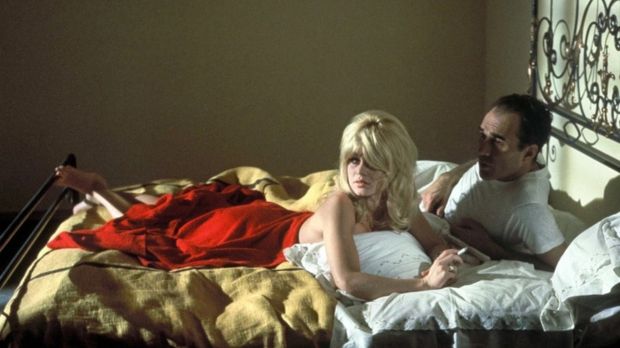
“Which do you like better, my breasts or my nipples?”
“I like them both.”
Correct answer! Every husband or boyfriend should take notes from this opening scene of Contempt on the tricky issue of How To Answer Questions From Your Naked Wife In Bed About Her Body.

Country: France.
Running time: 101 minutes.
Director: Jean-Luc Godard.
Writer: Jean-Luc Godard.
Based on: the novel Il disprezzo by Alberto Moravia.
Cast includes: Brigitte Bardot, Jack Palance, Michel Piccoli, Giorgia Moll, Fritz Lang, Jean-Luc Godard.
Links: Wikipedia, IMDB
(unranked), Cahiers du Cinéma 100 all time
#21, Sight & Sound (2012)
#54, Sight & Sound (2022)
#49, Village Voice 20th Century
Keywords: movie about movies, sex symbol.
Set in era: contemporary.
Is it well known? well known.
Had I seen this before? long ago in theater.
Compared to book: haven’t read it.
Overrated? very.
This opening scene serves as a notification to the viewer that there will be one — and, as it turns out, only one — reason to watch this movie: Brigitte Bardot* naked. From behind, actually. So it doesn’t matter which part of her front you like better, what you’re going to get is a lot of French sex-kitten derrière.
Even this gratuitous scene was said to have been demanded by producer Joseph Levine after the fact to sex up the movie. It certainly needed something. If they had put a homely actress in Contempt, and she weren’t naked some of the time, you wouldn’t watch it. It would be an incredible bore. In fact, it is anyway.
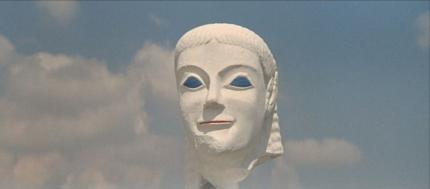
Contempt is about some people in fabulous locations in Italy SUPPOSEDLY making a movie that is SUPPOSEDLY The Odyssey. (Heard of it?) If you’ve seen any The Odyssey movies recently, consider yourself lucky that it wasn’t Godard’s, in which basically the camera circles around motionless classical statues against a blue sky, and finally our man Odysseus experiences his great triumph by holding his sword in the air against a blue sky.
Luckily, that’s not all! Also, naked girls frolic in the sea. The screenwriter (of the movie in the movie), Paul, settles into a folding chair on the pier as they get ready to film the naked frolicking part.
“Are they going to undress?” he asks.
“Of course.”
"Il est merveilleux, le cinéma,” he exults. “You get to watch women disrobe and stare at their ass.”
This is a statement of why we’re sitting through Godard’s Contempt and/or Godard’s fake filming of “The Odyssey.” Contempt itself is a generally boring movie that is widely praised and has been called “the greatest work of art produced in post-war Europe,” but I actually wish Godard had gone ahead and made his “Odyssey,” which would have been truly the worst film of the century, so I could see how the critics would have raved about it too.
I did see this movie in a theater sometime in the 1990s, and I left confused, like, is there something I was supposed to get? I really searched my mind because I was sure this was a significant work of art and there was some insight I wasn’t having. These days, I don’t go in for that. If the movie is blah, they made a blah movie.
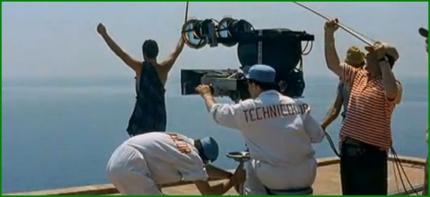
I guess part of the reason some people admire this kind of filmmaking is the same reason it’s cool to go to a restaurant with an open kitchen. It supposedly opens up the filmmaking gears to the audience. The first shot of the film shows an actress walking through Rome’s Cinecittá studios as a camera on a track films her and then rotates around to look directly at us. (This has nothing to do with the rest of the movie.) In the audio commentary, film scholar Robert Stam celebrates the contemplation of filmcraft embodied in the scene, as the credits are uncharacteristically spoken in voiceover instead of shown in titles. We see the gears turn — literally, in fact. But for any reason?
The centerpiece of Contempt is an extended, 30-minute couple’s quarrel between the character Paul and Bardot’s character, Camille, in an apartment with white walls and art of naked women. It’s the only part of the movie that tries to have some content in it. Sometimes it works for a minute or two. And yet, this film being a piece of abstract “art,” it keeps veering away from anything meaningful.
“There’s nothing to explain,” she says. “I don’t love you.”
“Why? Yesterday you loved me.”
“Yes, very much. Now it’s over.”
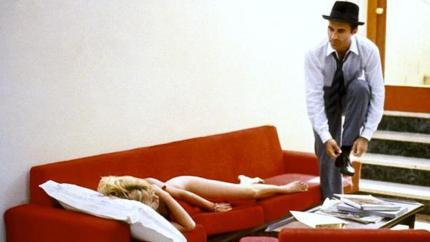
According to the DVD’s audio commentary, in the Italian novel this was based on, the couple’s alienation develops over time, so it is a possibly interesting process; in the movie, Camille just suddenly does a 180 and says I hate you. ("Je te méprise,” which gives the movie its French title, Le Mépris.) This is minutes after saying, “I love you just as before.” The film professor Stam mentions that the argument coincides with Godard’s breakup with his own wife — which perhaps he is ineffectually working through in a public (and accusatory?) way by making this senseless but clearly indignant movie.
After more bickering and a tense trip to Capri, land of the nude swimming nymphs, the movie finally resolves its barely-there plot with a big random occurrence, of the sort I hate. It’s the laziest screenwriting. And that caps a film that has obviously been made more to be analyzed than to be enjoyed. I don’t want to categorically dismiss everyone who for some reason loves Contempt, but honestly, is it because it’s an engaging story or is it a “text” to be deconstructed?
I can’t help but think that Godard’s point with this movie is basically “Bitches be crazy.” But you know how when somebody tells you every single other person is the problem and you start to realize maybe that person is really the problem? I’m just saying, if there’s one guy who makes a movie about himself where everybody else looks erratic, and their story doesn’t make sense, we are entitled to draw our own conclusions.
Notes
1. * Actually it’s possible some of the nude scenes were done by an 18-year-old body double in an outrageous Brigitte Bardot wig. (Godard didn’t like Bardot’s out-of-control hair and called it her “spaghetti.") Source: Richard Brody, Everything Is Cinema: The Working Life of Jean-Luc Godard.
2. Godard said of the film’s main character, the screenwriter — the second in the series of Godard-like Pauls initiated in Vivre Sa Vie — “Paul Javal is the first of my characters who is realistic, whose psychology can be explained — at a purely psychological level.” The character seemed realistic to Godard, of course, because it was so closely based on himself.
Richard Brody, Everything Is Cinema: The Working Life of Jean-Luc Godard
3. Producer Joseph Levine was irate after his experience working with the art-film auteur on what was supposed to be his first “Hollywood"-connected movie:
"It was the worst film we ever made — maybe the worst film anybody ever made. We lost a million bucks on that lousy film, because that great director Jean-Luc Godard refused to follow the script. He never would tell me what he was doing. He never even answered our cables. I told them it was people like Godard who were responsible for the sorry state of the French film industry, and that in my opinion Godard was personally responsible for the death of the New Wave.”
Quoted in The Very Rich Hours of Joe Levine, The New Yorker, September 9, 1967
The conversation
Mr. Godard sets interesting scenes, with provocative color combinations and a suggestive pictorial flow. But out of it all comes nothing—or very little that tells you why this wife is so contemptuous of her husband.
Bosley Crowther, 'Contempt’ Opens at Lincoln: Jean-Luc Godard Film Lacks His Style, New York Times, Dec. 19, 1964
The screenplay is credited to Mr. Godard, but I doubt whether an actual script could be found; never have I seen a picture that seemed more surely to have been made up as it went along, and while the backgrounds are beguiling— a smart flat in Rome, a remodelled castello in the campagna, a burnt-sienna villa overhanging the sea on Capri— what fails to happen in the foreground soon makes one’s mind numb with boredom. . . .
As for Mr. Piccoli, who is also often in dishabille, he presents a mystery by not once taking off his hat, even when bathing or going to bed. I assumed that the big scene in “Contempt” would be the moment of defedoration, but I was wrong; the picture grimly skirts big scenes of any kind in favor of a series of broken-off conversations.
Brendan Gill, The New Yorker, 1964
I have never been one to habitually praise Jean-Luc Godard. . . . So I told myself it would be quite interesting — if only to surprise my friends — to actually like “Le Mépris” a little. As it turned out, I had overestimated my capabilities. The feat was beyond my reach. Upon leaving the Vendôme, where the film was showing, I rushed into one of those bookstores that stay open late at night to buy a copy of Moravia’s novel, which I wanted to read. It seemed inconceivable to me that the book could be as empty, as naively pretentious, as intellectually vacuous as what I had just seen.
Robert Benayoun, France-observateur, 1963
If Contempt invents a new way of thinking about the world — combining the whole complicated business of shooting a movie with reflections on antiquity and modernity, love and filmmaking, sound and image, art and commerce, thoughts and emotions, and four different languages and cultures — it arrives at this vision mainly through a series of detours and roadblocks. Indeed, it might be argued that Godard fails as a storyteller, as an entertainer, as an essayist, and as a film critic in the very process of succeeding as an artist.
The broken rhythms of the storytelling in Contempt and the frequent slippages between stars and characters, characters and caricatures, films and ideas about films, incidents and ideas about incidents all point to innovative ways of thinking, as Godard enters the material from different angles to tease out its hidden meanings. And if these meanings take the form of a cubist mosaic rather than a linear narrative or argument, that’s because stories and essays take us only part of the way in perceiving the modern world and its contradictions.
Jonathan Rosenbaum, Critical Distance [on CONTEMPT], The Chicago Reader, 1997
If the film records the process of disenchantment, it is also a seductive bouquet of enthrallments: Bardot’s beauty, primary colors, luxury objects, nature. Contempt marked the first time that Godard went beyond the jolie-laide poetry of cities and revealed his romantic, unironic love of landscapes. The cypresses on Prokosch’s estate exquisitely frame Bardot and Piccoli. Capri sits in the Mediterranean like a jewel in a turquoise setting. The last word in the film is Lang’s assistant director (played by Godard himself) calling out “Silence!” to the crew, after which the camera pans to a tranquilly static ocean. The serene classicism of sea and sky refutes the thrashings of men.
Philip Lopate, Contempt: The Story of a Marriage, Criterion.com, 2002
“Contempt” is not one of the great Godard films, for reasons it makes clear. In a way, it’s about its own shortcomings. A drama exists at ground level involving the characters, while the film fights between the tendency to elevate them into art (Lang) or vulgarize them into commerce (Palance). It is interesting to see, and has moments of brilliance (the marital argument, the use of the villa steps), but its real importance is as a failed experiment. “Contempt” taught Godard he could not make films like this, and so he included himself out, and went on to make the films he could make.
Roger Ebert, Contempt, 1997
Country: France.
Running time: 101 minutes.
Director: Jean-Luc Godard.
Writer: Jean-Luc Godard.
Based on: the novel Il disprezzo by Alberto Moravia.
Cast includes: Brigitte Bardot, Jack Palance, Michel Piccoli, Giorgia Moll, Fritz Lang, Jean-Luc Godard.
Links: Wikipedia, IMDB
(unranked), Cahiers du Cinéma 100 all time
#21, Sight & Sound (2012)
#54, Sight & Sound (2022)
#49, Village Voice 20th Century
Keywords: movie about movies, sex symbol.
Set in era: contemporary.
Is it well known? well known.
Had I seen this before? long ago in theater.
Compared to book: haven’t read it.
Overrated? very.