
For heaven’s sake


Here’s what I was afraid of: In 1963, Lilies of the Field catches Sidney Poitier in a moment when he’s America’s “acceptable” black face in the movies, and before 1967, when he’ll be in two movies that use his acceptability to more directly confront the subject of racism. I was afraid this would be a “safe” movie.
And it is a “safe” movie. Harry Belafonte, the other huge black star of the day and one known for his uncompromising activism, turned down the role, calling the script “highly meaningless” and “nonthreatening to the culture.” And he was right. But there is a bit of a twist that makes Lilies of the Field much less cringey than let’s say Driving Miss Daisy. (This and other details come from the book “Sidney Poitier: Man, Actor, Icon” by Adam Goudsouzian.)
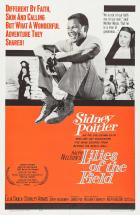
Country: United States.
Director: Ralph Nelson.
Writer: James Poe.
Cast includes: Sidney Poitier, Lilia Skala, Stanley Adams.
Links: Wikipedia, IMDB
Is it well known? moderately.
How did I see it? home.
Had I seen this before? never before.
Compared to book: haven’t read it.
Academy Awards:
Actress (nominated)
Supporting actress (nominated)
Adapted screenplay (nominated)
Cinematography (b/w) (nominated)
Best picture (nominated)
Actor (winner)
Cinematography (b/w) (nominated)
Golden Globes:
Best drama (nominated)
Actor drama (winner)
Supporting actress (nominated)
The basic story is, Homer Smith — a black Army veteran driving a white Plymouth station wagon from somewhere to somewhere else in search of a new life — is forced to stop at a country house in the Arizona desert when his car overheats. There he finds an unlikely fivesome of German Catholic nuns, only one of whom speaks English.
“My car is thirsty. Can I please have some water?” he asks, a little weirdly.
“God is good. He has sent me a big, strong man,” Mother Maria exults.
“He didn’t say anything to me about sending me anyplace. I was just passing by,” he says.
“Yet, you did not pass,” she notes.
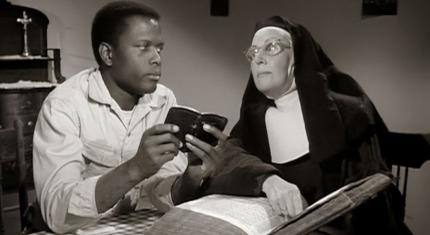
The women have a need for a big, strong man to fix their roof, but Homer has to be on his way. And yet (in a moment I really didn’t like because of the dramatic overacting), a few yards down the road, Homer stops, pulls the money out of his wallet, counts the small number of bills, looks back at the nuns, looks back at his wallet, and gives a big silent-movie-style shrug lest we miss his motivation in going back to do the roof job. Oy, I was already saying to myself this early in the movie. It’s going to be a long one.
Mother Maria, persuasive to the point of pushy, won’t hear of Homer moving on toward his destination until he has done what the Lord brought him here for, which is to build a chapel, which she pronounces “Shapel.” (Which is a weird inaccuracy, because the actresses are real German speakers and in German the word would be Kapelle with a “K.” They should say, “We need to build a ‘kapel.’ ")
Homer gets invested in the job to the point that he takes a part-time construction job in town to buy both building supplies and food for the sisterhood. More than that, he gets invested in his relationship with these women who have, of all places, found themselves transported from East Germany to the Arizona desert.
And this is what raises the movie above completely appalling. If the sisterhood were a group of American nuns, this would look really atrocious. “Oh, Homer, won’t you smile and bow your head and say yes ma’am and obediently do what we tell you?” “Oh, yes ma’am, yes ma’am.” That’s a completely different story.
In this case, the women are fish out of water even more than Homer is, and there’s the barest hint that they’ve perilously fled Godless Communism to be here. The Berlin Wall having been built just two years earlier, their plight is fresh in the audience’s mind.
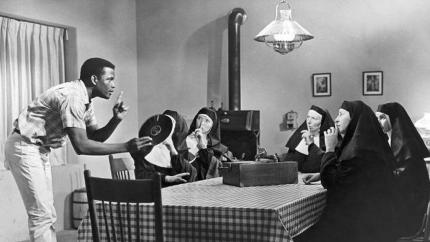
Homer gamely teaches the sisters some English, and, in a scene that I actually thought was quite nice, teaches them to sing the spiritual “Amen” (their part is just one word!) while he sings the interstitial lines. He has already pointed out that as a Southern Baptist he wouldn’t seem to fit with their flock, but they share a joyous musical moment transcending differences in both language and denomination. Part of what’s nice about this is, people burst out in song for less reason than this in a lot of movies, but in this case the singing truly is a bridge between the characters.
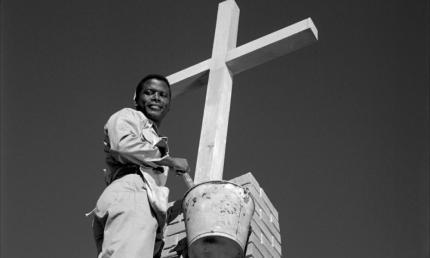
This being a Catholic milieu in the southwest, the whole Mexican-American community joins in the building of the chapel, which is going to be primarily theirs, and that just about wraps up our story. It’s meant as quite the feel-good all-together-now movie, and so it was at the time, with Poitier even winning a best-actor Oscar and everyone going home happy.
Today, I would tend to say that nobody would make a movie like this because it doesn’t do anything. Oh, look at the nice interracial people learning to get along! But I would probably be wrong because they gave Oscars to Driving Miss Daisy, Crash and Green Book.
Even in 1963, though, a lot of people found this feelgood movie a copout. Voices in the black press criticized it severely, and with justification. I can see what they were trying to do at the time, and in fact when the Mexican community gets involved it does become a less galling movie, but I can’t imagine anybody wanting to watch it today*. Close the book on Lilies of the Field.
Notes
1. Director Ralph Nelson appears as the construction company owner who helps with the chapel and gives Homer a side job. From what I’ve read (I no longer have the books at hand), it was a bit of a shoestring operation, so the director put himself in a role and promo-ed the real construction company in Tucson that helped out the production.
2. A cafe owner who is a hub for the Chicano community is played by Stanley Adams, who also filled the USS Enterprise with adorable tribbles in the famous Star Trek episode The Trouble With Tribbles.
3. The New Yorker has a very interesting article about Sidney Poitier’s career, including the importance of this movie in it.
Poitier viewed himself as “a dark horse, so to speak,” and considered not attending [the Academy Awards]. Ultimately, he decided that “it would be good for black people to see themselves competing for the top honor,” he wrote, in “This Life.” As he sat in the audience, sweating and alone, he was seized with the fear of winning and saying something “dumb.” He recalled his inner monologue: “Think, Sidney, think, time is of the essence! Whatever I say must be the truth first, and it must be something intelligent and impressive that will leave the people in that room and the millions watching at home—leave them all duly and irrevocably impressed with the intelligence and decorum of one black actor, Sidney Poitier.” The line he came up with, and delivered moments later, on the stage of the Santa Monica Civic Auditorium, was laden with meanings: “Because it is a long journey to this moment, I am naturally indebted to countless numbers of people. . . .”
Poitier’s post-Oscar period was fruitful but frustrating. “I was now viewed as a fixture in the film world,” he wrote, “but my fellow black actors, almost to a man, were trapped in a drought of inactivity and unemployment that sapped and embittered whatever satisfaction they may have derived from the success of a single one of us.” As with McDaniel, the prize had ossified him, especially as times changed. In 1967, he starred in three films, whose combined box-office receipts made him the No. 1 star in America: “To Sir, with Love,” “In the Heat of the Night,” and “Guess Who’s Coming to Dinner” (Poitier, incredibly, wasn’t nominated for an Oscar for any of them, though his white co-stars Rod Steiger and Katharine Hepburn both won.) In each, he played a “civilized” Black man whose extraordinariness helps enlighten the regressive white characters who are forced into his company. Perhaps no celebrity could encompass the cultural crosscurrents, but Poitier, at his height, found himself ripe for taking down. That September, the Times ran an astonishing column, by the Black writer Clifford Mason, titled “Why Does White America Love Sidney Poitier So?” Harking back to Poitier’s Oscar-winning role, Mason predicted that “until the day of complete honesty comes, white critics will gladly drag out a double standard and applaud every ‘advance’ in movies like ‘Lilies of the Field’ as so much American-style, democratic goodwill. Which is what the road to hell is paved with.”
The stunned Poitier called it “the most devastating and unfair piece of journalism I had ever seen.” But he noticed a resentment even among his Black peers, who “knew a naked truth about Hollywood: the motion picture industry was not yet ready to entertain more than one minority person at that level. I knew it too, and I couldn’t fight that.”
Michael Schulman, The Meaning of Sidney Poitier’s 1964 Oscar, The New Yorker, 2022
The conversation
* In spite of what I wrote above, reviews from the current era show that some people are still enjoying this movie’s happy face on race.
In our time, the cinema is struggling to adapt to the changing tastes of audiences and remain culturally significant. Lilies of the Field predates the modern self-consciousness of film’s preoccupation with diversity and cultural characterizations. Instead of being a movie about a socio-political message, it is instead an unpretentious film about people of different backgrounds working to find some kind of common ground. This is the kind of story that transcends time and place — and one sorely needed today.
James Day, 58 Years Later, the Classic ‘Lilies of the Field’ Still Bridges Racial and Religious Divides, National Catholic Reporter, 2021
You could pretty much predict most of the beats in Lilies of the Field. Of course, the whole desert community rallies around to help. Of course, Smith and Nuns reach an understanding of mutual affection. Of course, the building contractor Smith works for part-time to keep himself in dollars (played by the director Ralph Nelson) overcomes his condescension to Smith to chip in. Of course, Smith falls in love with the chapel – and sees it as a chance to live his dream of becoming an architect. None of this should surprise you.
But it works because it’s all quite gentle and charming. A big part of this is down to Poitier’s performance. So many of his roles dripped with nobility and grandeur, that it’s really pleasant to see him cut loose and have some fun.
Alastair Nunn, MovieMusings.uk
Contemporaneous reviews in the mainstream press found the movie likeable:
Sure it’s “Going My Way” with a Negro (and without the songs) in mood and moral. But we can do with a nice chunk of sweetness and optimism in a movie, for a change.
Bosley Crowther, A Disarming Modern Parable; Sidney Poitier Stars in ‘Lilies of the Field', The New York Times, 1963
Although Poitier is a Negro, and plays a Negro, the role is not that of any Negro stereotype, however well intentioned. The character is a universal young man, today’s young man, hep, flip and yet with a longing to create, to build something of enduring value in a world where the bulldozer seems designed to level impartially hill and home. Poitier has had little opportunity to display his comic talents. He shows here his timing and technique are impeccable. His relationship with the five women is delicate — not because of difference in race but of sex — and plays beautifully.
The Hollywood Reporter, 1963
It was hard to track down any of the backlash in the black press at the time, which is only made brief mention of in one of the books on Poitier’s life, but the NY Times did print this unsparing takedown by Clifford Mason in 1967. I think there’s a lot to it. (Mason openly uses the n-word, and even though I don’t like censoring, since times are different and I’m not him, I’ve taken it out.)
All this Mr. Poitier endures, and more, without a murmur of protest. Now there are those who will say there’s nothing else he can do. They won’t let him make anything else. I used to console myself with the fact that that was probably true. And it may very well be true. But truer than that is the fact that he thinks these films have really been helping to change the stereotypes that black actors are subjected to. In essence, they are merely contrivances, completely lacking in any real artistic merit. In all of these films he has been a showcase ------, who is given a clean suit and a complete purity of motivation so that, like a mistreated puppy, he has all the sympathy on his side and all those mean whites are just so many Simon Legrees. . . .
Now Poitier may very well say that he is sacrificing his career so that eventually all God’s chillun will be able to do what white folks been doing for years. That would be a cute point, and I’d like to think it was true. But until the day of complete honesty comes, white critics will gladly drag out a double standard and applaud every “advance” in movies like “Lilies of the Field” as so much American-style, democratic goodwill. Which is what the road to hell is paved with.
Clifford Mason, Why Does White America Love Sidney Poitier So?, The New York Times, 1967.
Country: United States.
Director: Ralph Nelson.
Writer: James Poe.
Cast includes: Sidney Poitier, Lilia Skala, Stanley Adams.
Links: Wikipedia, IMDB
Is it well known? moderately.
How did I see it? home.
Had I seen this before? never before.
Compared to book: haven’t read it.
Academy Awards:
Actress (nominated)
Supporting actress (nominated)
Adapted screenplay (nominated)
Cinematography (b/w) (nominated)
Best picture (nominated)
Actor (winner)
Cinematography (b/w) (nominated)
Golden Globes:
Best drama (nominated)
Actor drama (winner)
Supporting actress (nominated)