
Franz in high places


I wonder if you’ll find The Trial quite so brilliant if you weren’t a depressed kid who read all the alienation literature you could find and thought Franz Kafka’s novel was a masterpiece. If you weren’t that kid, you might sit through this film and say, “What was that and why did I watch it?” If you were that kid, you’ll say . . . “Wow, yeah, they did it.”
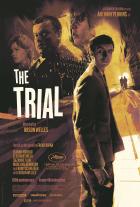
Country: France.
Running time: 118 minutes.
Director: Orson Welles.
Writer: Orson Welles.
Based on: the novel The Trial by Franz Kafka.
Cast includes: Anthony Perkins, Jeanne Moreau, Romy Schneider, Orson Welles.
Links: Wikipedia, IMDB
Keywords: dystopia, surreal.
Set in era: contemporary.
Is it well known? moderately.
How did I see it? theater.
Had I seen this before? never before.
Compared to book: both are good.
Overrated? underrated.
The Trial is not a movie about Roberto Mosquera, a 59-year-old plumber with four daughters in Miami — but you know something, it also is.
Roberto Mosquera showed up in a government office to renew his work permit one day last year, and the next thing he knew he was in prison, and the next thing he knew he was in a different prison in the totally not fictional country of Eswatini. He faces no charges and he cannot appeal. (NY Times: He was deported to a country he’d never heard of. He may never go free.) And of course, he is one of tens of thousands.
Kafka told us we would do this and we did it.
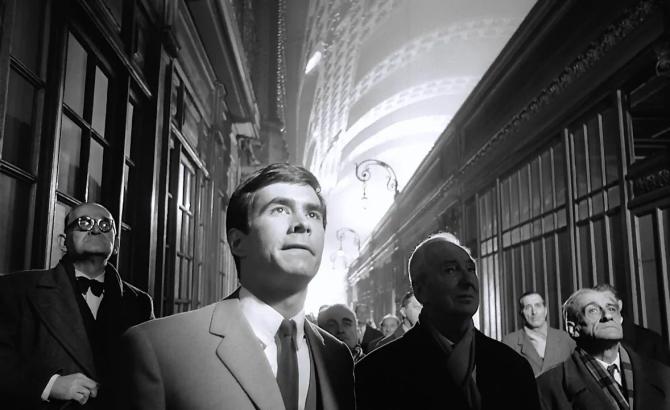
In the movie, Anthony Perkins is Joseph K, a plain, unexceptional office worker who wears a suit and lives in a modest apartment. (Get Norman Bates out of your head, because in this movie he hasn’t done anything.) At 6 a.m. one day, officers of the law enter his apartment, wake him up, and inform him that he is being charged.
Charged with what? How can he defend himself? How can he find out the first thing about what’s happening?
In Kafka’s special world, these questions don’t have answers and in fact are not even askable because the state does not avail itself to the human subject. It is reinforced at every step that K, as sincerely as he might seek justice and try to speak out against injustice, is a nothing. He is also us.
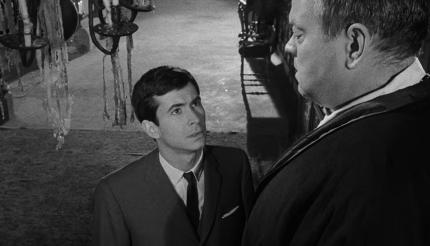
K’s quest to prove his innocence takes him from one surreal scene to another, from his own office in which endless clerks are typing at endless desks, to a powerful lawyer (played by Orson Welles) who lies in bed entertaining visits from rich and influential legal personages, to a fruitless chance to declare his case to a packed assembly, to a zombie-like assemblage of victims in an intriguing milieu that turns out to be Paris’s ornate Gare d’Orsay. K grasps for hope, he grasps for explanation, he grasps for a savior, or maybe even someone to accompany him in his aloneness. Welles is the perfect director to have made this weird journey — his lurid angles, lighting and locations are the only way to have communicated Kafka’s story in postwar cinematic language.
Welles referred to The Trial as his best film:
I feel an immense gratitude for the opportunity to make it, and I can tell you that during the making of it, not with the cutting, because that’s a terrible chore, but with the actual shooting of it, that was the happiest period of my entire life. So say what you like, but The Trial is the best film I have ever made.Orson Welles, BBC interview, 1962
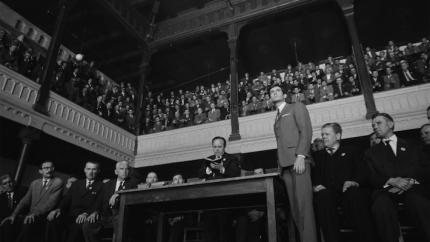
In context, he may have been saying that it was his best personal filming experience. Whatever he meant, this is an overlooked standout in his career, marrying his particular idiosyncratic talents to a novel that absolutely required them. Maybe nobody else in his era could have done it.
It is now 100 years since the publication of Kafka’s novel and more than 60 years since the making of this movie, and they should still have the power to make you mad. We have grown right into them.
Notes
Welles explained that he was in Paris with the cast and crew of the movie, and his shooting location in Zagreb, Yugoslavia, was delayed. They discovered that the shuttered Gare d’Orsay train station (which only opened as a museum in 1986) was available, so the movie’s cramped interior scenes were shot in the facility — if you’ve been to the Musée d’Orsay, you can tell that some of the scenes are there.
K’s almost infinite office was shot in a giant warehouse space in Zagreb, and it would appear that the exterior scenes around residential buildings were too. The movie benefits from socialist blankness as an architectural style. Welles also explained that Kafka’s native Czechoslovakia was pretty much off-limits in the communist era, but Yugoslavia less so, which makes sense given that Yugoslavia went its own way politically as an independent-minded (and cash-friendly) member of the communist bloc.
(I had a citation for all this and I forgot to write it down. Hmmph.)
The conversation
The response to the film in its own time was surprisingly — to me, at least — mixed to negative. François Truffaut, who was a longtime film critic before debuting as a director just three years before the release of this film, found much to criticize. (Maybe thinking he would have done it better? He would not.)
The two reasons that I’d give for my disappointment — after noting, however, that the French critical response was generally excellent — are that Welles, who is so much at ease filming power, pride and dominion, maybe isn’t equipped to show their opposites: weakness, humility, submission. Since his adolescence, his corpulence and size have naturally led him to play kings. One almost never sees Orson Welles eat or drive a car (except in The Lady from Shanghai). One often sees him stand up but never sees him sit down. . . .
Orson Welles is bigger than life, Kafka is smaller than life. This is why, filmed from the same angle as Gregory Arkadin or Charles Foster Kane, with the camera at floor level, Kafka’s hero, played by Anthony Perkins, remains distant and scarcely touches us. As Jean Cocteau put it: “The poet is a bird who must sing in his genealogical tree.” I have seen The Trial several times, and after impatiently awaiting each of Akim Tamiroff’s scenes, I have come to the conclusion that the film would have been Kafkaesque and moving if the cast had all been made up of Central European Jewish actors.
François Truffaut, foreword to Orson Welles: A Critical View by André Bazin, p 20-21
Whatever Franz Kafka was laboriously attempting to say about the tyranny of modern social systems in his novel, “The Trial” is still thoroughly fuzzy and hard to fathom in the film Orson Welles has finally made from the 40-year-old novel. Evidently it is something quite horrific about the brutal, relentless way in which the law as a social institution reaches out and enmeshes men in its complex and calculating clutches until it crushes them to death. At least, that is what this viewer gathers from the crazy and symbolistic stuff that Mr. Welles and an excellent cast of actors have regurgitated on the screen.
Bosley Crowther, 'The Trial’ Still an Enigma: Welles Compounds the Murkiness of Kafka, The New York Times, 1963
What a movie version of “The Trial” requires isn’t exotic settings, weird camera angles, and voices echoing hollowly down improbable passageways but a bleak, bland ordinariness of film and sound, in which every setting, every action is precisely what it appears to be. Outrageous reasonableness is the iron rule and may not be violated. Have I sufficiently indicated that I think Orson Welles is the last man on earth who ought to have made a movie of “The Trial”?
Brendan Gill, According to law, The New Yorker, 1963
Perhaps feelings have changed with hindsight. Here’s an essay by Jonathan Lethem via Criterion that absolutely mirrors my thinking.
Welles’s interrogation of Kafka’s subtext wouldn’t mean much if the director hadn’t found a cinematic language equal to the novelist’s distinctive effects: those careening yet gnomic set pieces; the tonal vertigo that seems to excavate the underside of ordinary existence; and, above all, the serene, dreamlike juxtapositions and jumps, so incontrovertibly lucid, that give Kafka’s writing its crazy power. Who better than Welles, really, to depict the discontinuous spatiality that caused Jorge Luis Borges to compare Kafka to the Greek philosopher Zeno of Elea? Preparing to shoot, Welles drew up designs for elaborate sets he wasn’t allowed to create—some of the sketches survive, possessing an expressionistic power perhaps most closely approximated in the final film by the slatted cage that houses the sinister court painter Titorelli (William Chappell).
Yet Welles’s employment of found locations, including the vacated Gare d’Orsay train station in Paris, worked better than any sets could have done. The movie shatters multiple European cities into fragments, crushing together antiquity and modernity, and claustrophobia and barren enormity, to form a labyrinth that grips K. as tightly as the teeth of a vise.
Jonathan Lethem, The Trial: Crime of the Century, Criterion.com, 2023.
Country: France.
Running time: 118 minutes.
Director: Orson Welles.
Writer: Orson Welles.
Based on: the novel The Trial by Franz Kafka.
Cast includes: Anthony Perkins, Jeanne Moreau, Romy Schneider, Orson Welles.
Links: Wikipedia, IMDB
Keywords: dystopia, surreal.
Set in era: contemporary.
Is it well known? moderately.
How did I see it? theater.
Had I seen this before? never before.
Compared to book: both are good.
Overrated? underrated.