
Say anything


It’s right there in the title — The Silence. There’s a lot of silence.
Two women and a boy ride a train in silence for a long time. The silence is interrupted by coughing by the sick sister, Ester. They finally arrive somewhere and stay in a hotel until Ester can get better.
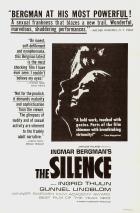
Country: Sweden.
Director: Ingmar Bergman.
Writer: Ingmar Bergman.
Cast includes: Ingrid Thulin, Gunnel Lindblom, Jörgen Lindström, Birger Malmsten, Håkan Jahnberg.
Links: Wikipedia, IMDB
Keywords: uneventful, travel, hotel, sisters.
Is it well known? less.
How did I see it? theater.
Had I seen this before? never before.
The rest of the movie happens in a hotel somewhere that is not specified but is like Albania. In fact, I’m going to rewrite that. The rest of the movie is located in a hotel somewhere that is not specified but is like Albania. The word “happens” is an overstatement, because the amount of time in which anything happens is a small fraction.
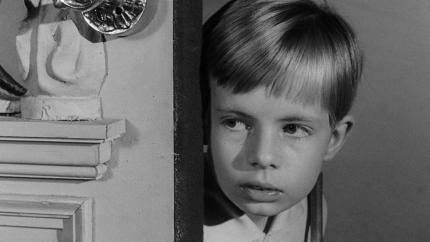
There is, I guess, one plot development, which is that sister Anna goes out into town a bit, where a cafe waiter brushes his face against her leg (huh?), causing her to, of course, arrange a tryst with him in the hotel. Her son, Johan, sees them go into a room together and is confused. Is that even a plot development, or is it just another trifle that the characters do in the course of the movie, like bathe and look out the window? The sisters argue about it later. Plot. Whoopee.
If you, like me, are bored by arty movies in which very little happens, you now know what you will think of The Silence. If we must discuss it further, we’re going to find ourselves in the realm of Deeper Meaning.
Deeper Meaning is what film-studies people think happens during long closeups when people’s faces betray the least emotion possible. Also during routine activities that we all do every day without contemplation but movie characters do with contemplation that we impute to them. Ever since early days when they discovered that viewers project emotion onto on-screen characters with blank faces, it’s been a game of how little can The Great Directors give the audience and how greatly will they rise in the pantheon of directors by doing it.
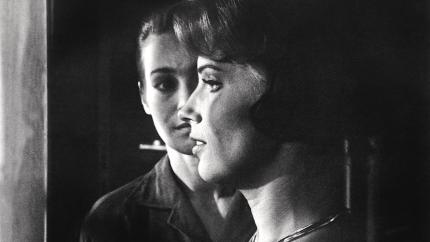
We start the movie aboard a train with our film’s trio and this sets up the most basic questions: Where are they going? To do what? There seems to be tension between the sisters — why? But answering questions is an indulgence of the popular audience, not the refined one. We are never getting anywhere. Instead, we just get off the train, check into a hotel and moulder there.
The one bit of intense acting required is by Ingrid Thulin as Anna, who has something like tuberculosis and lies in bed coughing, but at one point really writhes in agony and thinks she’s dying. She does this well. And yet . . . I mean . . . go to a fucking doctor. Get some antibiotics. You’re richer than everybody there. If they don’t have doctors in fake-Albania, take a train to Italy or Austria in the multiple days you’re spending in bed moaning. Jeez.
This is me — this is who I am. I don’t like “art” movies where things don’t happen. I am on the opposite side of “film studies,” which I guess is why I’ve created this web site which perhaps no one will read. Give me Casablanca and The Manchurian Candidate and The Ox-Bow Incident, not this.
Criterion has some extras for The Silence, including a 2003 commentary by Bergman in which he says (almost remorsefully!) that there are 34 to 38 exchanges of dialogue in the movie. “I wanted to make a film without dialogue. A true cinematography,” he explains.
That has actually been done well, but this isn’t one of those times.
The head of Svensk Filmindustri said he told Bergman, “Well, this film won’t have audiences running to the theater.” But contrary to expectations, it did well. He says they were offered 1.3 million kroner by a German distributor, who made the equivalent of 130 million kroner in the end.
I know why. It had boobs but they were art. A story as old as art itself. The Svensk guy says lists of times for the hot scenes were published so people could show up for the good parts while sparing themselves some of the otherwise endless tedium.
One way in which The Silence is awkward today is in two scenes when a troupe of jolly dwarves appear. I think the great movie Living in Oblivion did for casting dwarves as novelties what Hollywood Shuffle did for casting black actors as pimps — made it rather beyond the pale. Pushed us another step toward just treating people as people. I haven’t forgotten Peter Dinklage in that movie:
“Have you ever had a dream with a dwarf in it? Do you know anyone who’s had a dream with a dwarf in it? No! I don’t even have dreams with dwarves in them. The only place I’ve seen dwarves in dreams is in stupid movies like this! ‘Oh make it weird, put a dwarf in it!’ Everyone will go ‘Whoa, this must be a fuckin’ dream, there’s a fuckin’ dwarf in it!’ Well I’m sick of it! You can take this dream sequence and stick it up your ass!”
I hesitate to be so blunt, but you can take this movie and, um, watch it if that’s your thing. Or pass.
The conversation
• A report from the ground in Sweden before the movie touched US shores:
Ingmar Bergman has shaken the Swedish moviegoing public as never before and the Swedes have reacted by storming the box office. . . . The drama has three erotic scenes that some observers say are the most daring ever shown to filmgoers. As a result, Sweden is still churning with debate on whether the film is pornography or art. Many hundreds of articles and letters by the public have been printed by newspapers and magazines. The majority view, however, appears to be that “The Silence” is an artistic triumph for Bergman.
Werner Wiskari, On the international scene: Controversy in Sweden, The New York Times, 1963
• Review in The New Yorker:
There are, of course, a hundred ambiguities inside the narrow compass of “The Silence,” many of which I look forward to ravelling out at odd hours for the rest of the winter; meanwhile, let me assure you that while you won’t enjoy the picture — it is one of the least enjoyable pictures I ever sat through — you will find plenty of rewards along the way, among them its high pictorial interest (unlike its immediate predecessor, with its cold desiccation of landscape and bleak architecture, “The Silence” is all stifling heat and pillowy opulence of interior decoration) and the superb acting of Ingrid Thulin and Gunnel Lindblom, as the two sisters, and Hakan Jahnberg, as the servant.
Brendan Gill, No contest, The New Yorker, 1964
• Bravo to the following letter-writer:
Bergman has now turned his camera totally inward, and what it finds is not cinematically interesting. Further, his personal engrossment with retching, first made apparent in “The Virgin Spring,” now totally absorbs him. Ingrid Thulin starts regurgitating in the opening sequence and continues to do so throughout the film until she ends by spitting up life itself. The empty hotel he uses is so like the baroque corridors and rooms of “Marienbad” that it seems the repetition of a cliche.
But one message of the picture is more or less understandable to anyone who’s been seriously ill — that every man faces death in a strange country peopled by faceless, unfeeling strangers speaking an incomprehensible tongue.
I think that with this movie, Bergman has gone as far as he can with self‐expression. He has lost contact with the audience, it seems to me. Also, this kind of moviemaking seems extremely selfish, as well as self-defeating. He uses other people and a lot of our time to express his own inner concerns in a language that only he — if anyone — can understand.
Walter Ross, Letter to the editor, New York Times, 1964
• This modern-day review makes about as convincing a defense as possible of the film’s “nothing happening” nature:
The Silence is a film of negation. The first words spoken - the first of not very many, at that - are a declaration of ignorance and meaninglessness. A boy of ten or eleven, Johan (Jörgen Lindström) points to a sign written in an unfamiliar language, asking, "Vad betyder det?" (What does that mean?). Off-camera a tired-sound woman, his aunt Ester (Ingrid Thulin) replies without a trace of affect: "Jag vet inte" (I don’t know).
In a sense, we’re all done. The remainder of the film’s 95 minutes will be little more than expanding on this moment, and its implications. A necessary expansion, maybe, and certainly a rich one. The Silence is generally referred to as the third in a loose stylistic and thematic trilogy of films written and directed by Ingmar Bergman that began with Through a Glass Darkly in 1961 and continued with Winter Light earlier in 1963: a matched set of chamber dramas that track the loss of faith in a loving God who hears us and responds, replaced by a fear that God does not speak and may not exist at all (that is, by most accounts, the specific silence that the title refers to). That’s in it, of course, but The Silence feels a whole lot bigger and more thematically inquisitive than those films, covering more ground and taking place in a larger world than their tightly-restricted pockets of rural Sweden.
Tim Brayton, All alone, AlternateEnding.com, 2020
• Lastly, Rober Ebert — who I’m sure had seen the movie numerous times, being a Bergman aficionado — wrote a whole review of it in 2008 giving an analysis of its symbolism but never specifically saying that it was good, other than giving it a pro-forma four stars. So interesting.
The film is oblique. Most of the rest of the story involves reading between the lines. I could turn analytical and point out that Anna, who picks up a man and has sex with him in the hotel, represents Body, and that Ester, who works and reads in bed and at the table in her room, represents Mind. The doorway between their rooms is the portal through which they stage their rivalry, and only Johan passes back and forth thoughtlessly. I think the boy is the key to the film — in what way, I’m not sure.
Roger Ebert, The last in the Bergman trilogy about the silence of God, 2008
Country: Sweden.
Director: Ingmar Bergman.
Writer: Ingmar Bergman.
Cast includes: Ingrid Thulin, Gunnel Lindblom, Jörgen Lindström, Birger Malmsten, Håkan Jahnberg.
Links: Wikipedia, IMDB
Keywords: uneventful, travel, hotel, sisters.
Is it well known? less.
How did I see it? theater.
Had I seen this before? never before.