
1/2 baked


Okay, if you’re a cinephile, today’s the day you start to hate this web site.
Here is an accurate description of the movie 8½. Federico Fellini, having made 7½ movies in his career, decides to make his 8½th movie a whinefest about a movie director whose life is tough because genius is such a lonely burden. We know our protagonist is a genius filmmaker because . . . well, actually, he doesn’t do any filmmaking in the movie. So we don’t know that.
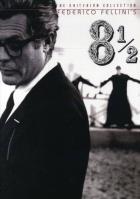
Country: Italy.
Running time: 138 minutes.
Director: Federico Fellini.
Writer: Federico Fellini, Tullio Pinnelli, Ennio Flaiano, Brunello Rondi.
Cast includes: Marcello Mastroianni, Claudia Cardinale, Anouk Aimée, Sandra Milo.
Links: Wikipedia, IMDB
Keywords: uneventful, movie about movies, writer's block.
Set in era: contemporary.
Is it well known? well known.
How did I see it? home.
Had I seen this before? never before.
Overrated? very.
(unranked), Cahiers du Cinéma 100 all time
#65, Empire Mag World Cinema 100
(unranked), NYT top 10 (1963)
(unranked), Ebert Great Movies
#10, Sight & Sound (2012)
#31, Sight & Sound (2022)
(unranked), Spike Lee essential films
#136, Village Voice 20th Century
Academy Awards:
Original screenplay (nominated)
Foreign (winner)
Director (nominated)
BAFTA awards:
Best film (nominated)
So this is not, despite the claims of film people for whom this is their favorite genre, a “movie about the movies.” What’s it really about? It’s really a male fantasy about Being Marcello Mastroianni.
One woman after another does it or wants to do it with Marcello Mastroianni. (And I mean . . . yeah, for sure.) This is why when you’re making a movie that’s essentially about yourself, you cast Mastroianni and not some joe schmo. Some Giuseppe Schmo.
Since we’re looking at the year 1963, it’s worth noting that this makes 8½ just another entry in the most common theme of that year, the Ladies Can’t Resist This Guy movie. It’s Paul Newman in Hud, it’s Steve McQueen in Love With the Proper Stranger, it’s Sean Connery in Dr. No, and it’s Albert Finney in best-picture winner Tom Jones. The only comparably common theme for the year is the Woman Who Ends Up Needing A Procedure movie, which absolutely tracks.
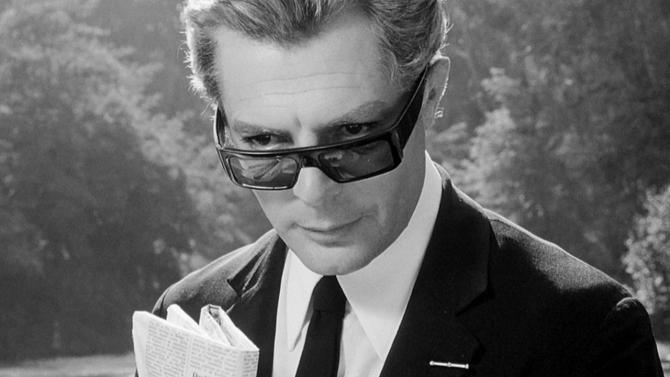
Our hero, Guido, is sent to a spa for some kind of rehab, essentially for his anxiety, but also the whole film world and his wife and mistresses follow him there to drink coffee and make occasional comments and fuck him. Plus, a ten-story scaffolding is being built for some kind of a rocket-launch scene, right next to the sanatorium — even though the “film” is going to exactly mirror his stay in rehab, which features no rocket launching.
It doesn’t need to make sense, because there’s no real story so there’s no need to make a story work. Guido doesn’t do anything in the movie — he only has encounters. Mixed in there are fantasy cutaways about the Freudian factors that might be making him feel creatively stifled — bits about religion, no make that childhood carnal feelings, no make that the demands of success. Or whatever. I guess you could sell this as a deep exploration of the self, if you see anything in this movie other than moping.
There is one scene where he risks doing some filmmaking because they’re holding auditions for the non-movie movie, but he is bored and walks out to talk up some babe. (I’m bored too! I would also rather be talking up some babe!) People who love 8½, I would be interested to know if they can identify anything that he does in the movie.
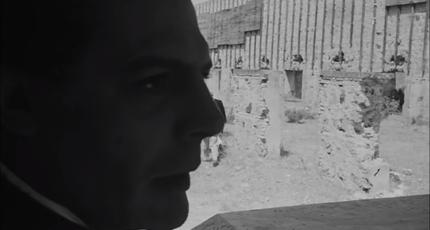
There are two things done well in 8½. One is the photography. And when you’ve got Mastroianni combined with Anouk Aimee, other fashionable euros, and you’re in Italy, you kind of can’t miss. A motif of the movie is a nearly uncomfortable closeup of one or more actors with some perfectly beautiful architecture or lush trees far in the background — you see that quite often. It’s what leads to headlines like "Is Federico Fellini’s 8 1/2 the coolest film ever made?" (Answer: no.)
The second thing is a shifting between conscious life and dream life, which — although this is not the coolest film ever made — is kind of cool. And yet, it’s also true of Billy Liar, a goofier but much more enjoyable movie from the same year.
Something I realized (after many years) in preparing to launch this web site is, why film studies people love the wrong movies. It’s because there are three kinds of moviegoers, and film studies people are the worst.
1. There’s the public. They want one thing: to sit in a seat and be super-entertained. Last year’s top movie at the US box office was A Minecraft Movie, a thing I didn’t even know existed. Apparently people had a good time seeing it, which was what they were there for. It was followed by Lilo & Stitch, Zootopia 2, Avatar and Superman. Fine.
I want to emphasize that this is the real movie experience. If you’re writing about film or analyzing film, you are spending two hours in your head, not in the movie.
2. There’s me. I want a really good, smart story that has an effect on me. If there’s no story, or the story is dumb, I see no reason for you to have made your movie. I’m still kind of like Group 1 in this regard: I want to sit in my seat and get absorbed in the movie and feel it. If I can stop myself thinking and analyzing as a writer, I can try to still have the movie experience. And then . . .
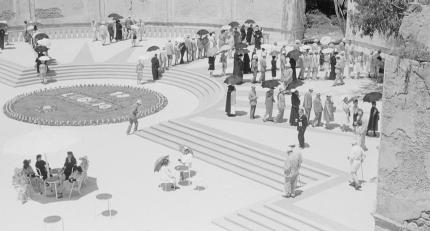
3. We have film professors and critics. This is what I realized about film studies: It focuses on technique. If you want a well-written story, that’s actually a different department — that’s creative writing or screenwriting or even playwriting. That happens in some windowless room in the basement if not a whole different school. In film studies, they study Orson Welles’s camera angles and Sergei Eisenstein’s edits. Technique.
In film criticism, it’s a badge of honor to praise a movie with no plot. It’s a monkish denial of worldly indulgences. It’s superior. The critics in the famous Sight and Sound poll have decided that the #1 greatest achievement in film history is one in which a woman stays home and cleans house for three and a half hours.
I don’t hate technique. For me it’s special (but not necessary) when creative moviemaking is part of the storytelling, as in The Diving Bell and the Butterfly, Children of Men and Eternal Sunshine of the Spotless Mind — all, to me, among the best movies ever made. The last 25 years have been a golden age for that.
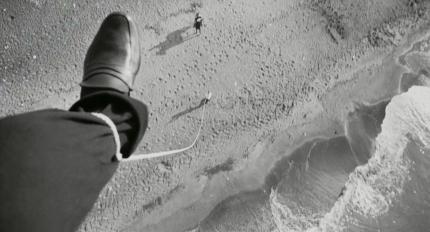
And in the olden days of 1963, when you couldn’t have made an Eternal Sunshine? Well . . . thanks to this project, I’ve also just seen Orson Welles’s The Trial for the first time, and what a contrast that film is with this one. Like 8½, it’s dreamlike, unpredictable and surreal. Unlike 8½, it is not empty solipsism amounting to nothing. Welles’s film actually needs to push the bounds of realism to live up to Kafka’s original novel — and succeeds.
Give me something, I beg Fellini, and he gives me nothing. What is our actual story in 8½? It’s about a guy hangin’ out. Dress it up in technique all you want, but it’s a guy hangin’ out. There have been great guys-hangin’-out movies — Clerks, Withnail and I, Naked. Hilarious dialogue, great characters, disturbing psychology. Great stuff. Here we are just asked to look at Marcello Mastroianni’s pretty face and feel sorry for the poor schmo who made the movie after running out of ideas.
Notes
1. Overheard in a movie theater recently: “I love Eight and a Half! I wrote a paper on it.” Yep, that’s exactly the point.
2. I think every writer has had the impulse to respond to writer’s block by writing about a writer with writer’s block. This has only been successfully done in the case of Barton Fink. With that exception, writers and filmmakers should be told no, clear your head and then try something else.
3. I’d like to just quote these two paragraphs from Roger Ebert as a great illustration of how critics focus too much on technique — that’s even the word he uses here.
Fellini’s camera is endlessly delighting. His actors often seem to be dancing rather than simply walking. I visited the set of his “Fellini Satyricon,” and was interested to see that he played music during every scene (like most Italian directors of his generation, he didn’t record sound on the set but post-synched the dialogue). The music brought a lift and subtle rhythm to their movements. Of course many scenes have music built into them: In “8 1/2,” orchestras, dance bands and strolling musicians are seen, and the actors move in a subtly choreographed way, as if they’re synchronized. Fellini’s scores, by Nino Rota, combine snatches of pop tunes with dance music, propelling the action.
Few directors make better use of space. One of his favorite techniques is to focus on a moving group in the background and track with them past foreground faces that slide in and out of frame. He also likes to establish a scene with a master shot, which then becomes a closeup when a character stands up into frame to greet us. Another technique is to follow his characters as they walk, photographing them in three-quarter profile, as they turn back toward the camera. And he likes to begin dance sequences with one partner smiling invitingly toward the camera before the other partner joins in the dance.
Roger Ebert, Eight and a Half, 2000
I don’t mean to pick on Roger Ebert alone here. There’s a kind of criticthink where the more you get behind the scenes the smarter you are about the movies — in fact, the smarter a display you create of your knowledge about the movies. To my mind, you don’t want to be behind the scenes. It actually takes away from your ability to experience a movie through the audience’s eyes.
The conversation
There is no shortage of over-the-top praise for 8½, but this guy is so high he can’t even see the top anymore.
It is, to my mind, the motion picture motion pictures have been waiting for. It contains — without parody, with almost loving strokes of homage — virtually everything that has been aspired to in films from Griffith to 1963, and in such a way that these “influences” are never overt but latent and necessary parts of the overwhelming personal vision of this Italian director.
Simply, Fellini has successfully arrived at the heart of what the film (as poem, painting, book, play) was destined for: the question of illusion and/or reality.
The same heart as that of Shakespeare, Dostoyevsky, Tolstoy, Picasso, Proust, Joyce, Kafka, Genet, Beckett.
Jack Hirschman, Film Quarterly, 1963
And here is some more typical enthusiasm for 8½:
Unexpectedly and welcomely, “8½” is a comedy, and the hero’s plight and eventual salvation are, to an uncanny degree, disguised manifestations of joy. Life, Fellini seems to be saying, is often very hard as well as absurd, but oh, how desirable it is! How eager I am to come to terms with it, and how sorry I shall be to bid it goodbye! He conveys this, of course, by means that have nothing to do with speech; what these means are is his secret— his somersault—but they certainly include the remarkable performances he has secured from Marcello Mastroianni, Anouk Aimée, and Sandra Milo, as the hero, his wife, and his mistress, respectively; the photography, the intensity of whose blacks and whites moved me as no pretty befuddlement of colors ever could; an ingenious use of background music (even Wagner is made to do a funny turn); and a bold, witty, intelligent script, which Fellini wrote in collaboration with Tullio Pinelli, Ennio Flaino, and Brunello Rondi. “8½” is an important episode in Fellini’s life and a not unimportant one in the history of films.
Brendan Gill, Without a Net, The New Yorker, 1963
“8 1/2” is the best film ever made about filmmaking. . . . All of the images (real, remembered, invented) come together into one of the most tightly structured films Fellini made. The screenplay is meticulous in its construction–and yet, because the story is about a confused director who has no idea what he wants to do next, “8 1/2” itself is often described as the flailings of a filmmaker without a plan. “What happens,” asks a Web-based critic, “when one of the world’s most respected directors runs out of ideas, and not just in a run-of-the-mill kind of way, but whole hog, so far that he actually makes a film about himself not being able to make a film?” But “8 1/2” is not a film about a director out of ideas–it is a film filled to bursting with inspiration. Guido is unable to make a film, but Fellini manifestly is not.
Roger Ebert, Eight and a Half, 2000
Meanwhile, here are two reviews from the time that showed considerably more skepticism. Both are from women. Coincidence? Could there be a little tiny bit of subconscious male-fantasy fulfillment going on, where men see themselves through the super-cool Marcello and women are just watching some stuff on a screen? I mean, the movie engages in some obvious pop Freudianism, so why not this?
According to Fellini, we “need new criteria of judgment to appreciate this film.” Yeah. “In my picture everything happens,” says Guido, which is intended to mean that he is an artist-magician; but the man who trusts to alchemy is like the man who hopes to create a masterpiece in his sleep and find it miraculously there upon awakening. Fellini throws in his disorganized ideas, and lets the audiences sort out the meanings for themselves. 8½ is big, it’s “beautiful”: but what is it? Is it really a magical work of art?
This is the first (and, predictably, not the last) movie in which the director seems to be primarily interested in glorifying his self-imprisonment. And this failure to reach out imaginatively — which traditionally has been considered artistic suicide — is acclaimed as a milestone in film art by those who accept self-absorption as “creativity.”
Pauline Kael, I Lost It At The Movies
The film moves to a climax as Guido is forced by his affluent producer to cast his film and to appear at a press meeting. Guido goes to the press meeting in terror because he has nothing to say. The trappings of the film are complete - producer, production crew, sets, stars - but Guido, the director, has no script; he does not know the identity of his hero; he is frozen with silence.
From this point, the film becomes inconsistent and weak. Dream and reality are no longer distinguishable. Perhaps Fellini intended this confusion in order to represent Guido’s desperate estrangement from his present reality; but the confusion weakens the ending of the film. . . .
If the ending is taken seriously, then Guido’s problem becomes a big joke, a spoof. If Guido’s problem is taken seriously, then the instant-pudding ending is, at best, inadequate and vulgar.
Mary Batten, Film Comment, 1963
Country: Italy.
Running time: 138 minutes.
Director: Federico Fellini.
Writer: Federico Fellini, Tullio Pinnelli, Ennio Flaiano, Brunello Rondi.
Cast includes: Marcello Mastroianni, Claudia Cardinale, Anouk Aimée, Sandra Milo.
Links: Wikipedia, IMDB
Keywords: uneventful, movie about movies, writer's block.
Set in era: contemporary.
Is it well known? well known.
How did I see it? home.
Had I seen this before? never before.
Overrated? very.
(unranked), Cahiers du Cinéma 100 all time
#65, Empire Mag World Cinema 100
(unranked), NYT top 10 (1963)
(unranked), Ebert Great Movies
#10, Sight & Sound (2012)
#31, Sight & Sound (2022)
(unranked), Spike Lee essential films
#136, Village Voice 20th Century
Academy Awards:
Original screenplay (nominated)
Foreign (winner)
Director (nominated)
BAFTA awards:
Best film (nominated)