
Dr., uh ...


Maybe the most interesting thing about Dr. No, seen through today’s eyes, is that it’s — ONLY! — a little bit problematic. Which is amazing, because the novel it came from should be called Dr. Dude, No.
I’m pretty sure Dr. No was the first Bond film I ever saw, and I still have some affection for the classier, less gimmicky 007. Connery is still kind of my only real Bond. We’ve bonded. Ha.
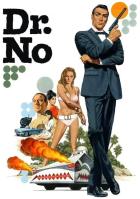
Country: United Kingdom.
Running time: 109 minutes.
Director: Terence Young.
Writer: Richard Maibaum, Johanna Harwood, Berkely Mather.
Based on: the novel Dr. No by Ian Fleming.
Cast includes: Sean Connery, Ursula Andress, Joseph Wiseman, Jack Lord.
Links: Wikipedia, IMDB
#7, US box office
#41, BFI Top 100 British Films
Keywords: deathtraps, james bond, spy.
Set in era: contemporary.
Is it well known? very.
How did I see it? small screen.
Had I seen this before? long ago in theater.
Compared to book: movie’s better.
Here — in what was the first Bond film but actually the sixth of the Ian Fleming novels — he is sent to Jamaica to investigate the disappearances of the top two intelligence personnel there. Through intrepid spy work, he locates and then unfortunately delivers himself into the clutches of the evil Dr. No, who has an underground lair on his own mini-island. Will this be the end of our hero?
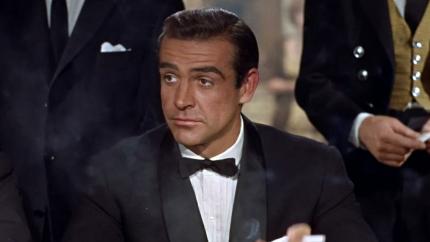
I hate to spoil it, but as you already know, the Bond franchise ended after this one movie, so I guess that was it for Mr. Bond.
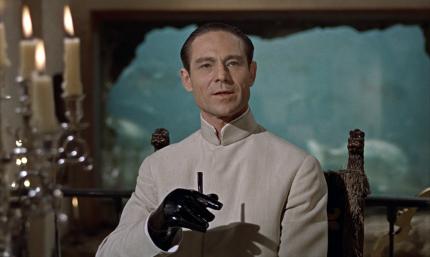
Dr. No the character is a half-Chinese mystery man, played by Canadian-born New York Jew Joseph Wiseman, because the idea of representation didn’t exist yet. What was required of the white actor playing Dr. No was a certain sinister exoticism, and (relying on the noted arts expert Wikipedia here), Wiseman was praised as "the spookiest actor in the American theatre" by the New Republic in 1964, so . . . perfect casting?
I decided to read the Dr. No novel before rewatching the movie, and it’s a page-turner. It is also, shall I say, of its time? As in the movie, Bond is dispatched to Jamaica, but all of the henchpeople who plague him on his mission are of the local ethnicities, most prominently . . . get ready for it . . .
“Finally there are the Chinese, solid, compact, discreet — the most powerful clique in Jamaica. They keep to themselves and keep their strain pure. Not that they don’t also take the black girls when they want them. You can see the result all over Kingston — Chigroes — Chinese negroes and negresses.”
Thanks, I would have figured that out.
There’s more, but that’s enough.
I liked Bond pretty well in the From Russia With Love era, when it was good clean Russia-fightin’ fun, but I finally got turned off of him by Live and Let Die (1973), in which I found the racism grossly obvious. Now, reading and rewatching the movie that started it all, I see that it was in the DNA. And why not? Bond is the British DNA.
I once heard an interview with the professor Marshall Blonsky, author of a book called American Mythologies, and he talked about the appeal of Rambo. Rambo was the perfect symbol for Americans in an era of anxiety about American decline. He reassured us that we could still conquer the world — we could even re-fight Vietnam and win — with the thing we were best at: world-class brawn, including our brawny guns.
I remember thinking, this is exactly what James Bond was for Britain. The British empire was disintegrating from the 1940s to the 1960s (Jamaica became independent in 1962), but Britain could still deservedly rule the world with the thing it was best at: sophistication. That’s what Bond is above all: sophisticated.
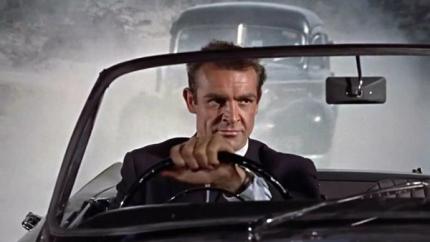
He dresses impeccably. He has a wry all-knowingness. He is at home in every far-fung locale and high-stakes casino in the world. He knows exactly how he likes his martinis — with vodka, Russian-style! Because he’s been everywhere! Britannia may no longer rule the waves, in the real world, but it still has intelligence, cunning and class. Especially class.
The boorish American empire doesn’t have that.
I still love Connery for the style he brought to the role. Later actors played Bond self-consciously, mimicking the patterns these first movies created because they eventually became a rote part of the franchise. But in Dr. No, they were a part of the creation.
“I admire your courage, Miss —"
“Trench. Sylvia Trench. I admire your luck, Mr. —"
“Bond. James Bond.”
When Pierce Brosnan says the same line, it’s like he’s wearing a suit he saw on someone else.
I’ve only checked in with the franchise sporadically — the only film I saw for years before the Daniel Craig era was Tomorrow Never Dies (1997), because I was on a plane and so was it. I found it mostly just dumb. (Even though the villain was basically Rupert Murdoch. Maybe more villains should be Rupert Murdoch.)
By that time, the movies had become scaffolding for elaborate action sequences, which have now become much more the point than anything you could call international intrigue. Is there any difference between a Bond movie, a Mission Impossible movie and a Bourne movie? We have John Wick, for Bond with more shooting, and Fast and Furious, for Bond with more driving. What’s happened over the decades is a kind of stunt inflation, where the stunts of 10 years ago would bore audiences today, and in fact, Dr. No feels quite basic in the thrills department when you’ve seen 60 years of action movies since then. But did action even exist before Dr. No? Maybe this is the granddaddy of them all, or certainly a grand uncle.
The movie ends differently from the book — maybe better, definitely cleaner and more filmable — and I’m just going to spoil it, Bond actually does defeat Dr. No and destroy his evil operation. Good old British daring has saved the (former 😢) empire again. Dare I say, the white man has ventured into the darkest depths of his (former 😢) colony, and recivilized it. Praise Bond.
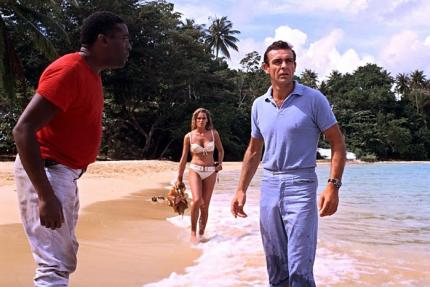
Who will be the next Bond? Everybody wants it to be Idris Elba, and, you know, in terms of all the things we’ve talked about — class, sophistication, intelligence, manliness, handsomeness and heroism — maybe he would be the best Bond since Connery. At the same time, Bond is not colonial, he is the long arm of the colonizer. Does Idris Elba — the son of a father from Sierra Leone and a mother from Ghana (I looked it up) — go to the Third World on behalf of the British Empire and kick the black people’s asses there?
Maybe — consider this — there should be no James Bond. There never should have been. What he said about Britain vs. the colonies was what we would call today a bad look. It doesn’t make sense to put Idris Elba in that role not because Idris Elba is wrong but because Bond is wrong.
On the other hand, I know I’m an overthinker. Maybe it’s fine and today’s Bond is just a generic globe-trotter who gets into scrapes in exciting locales all over the world. Like Volkswagen, Shell Oil and de Beers, he is a brand. He has evolved.
Notes
1. Under keywords I have included the word “deathtraps,” which is my name for when the villain doesn’t efficiently kill the hero; instead, he dreams up a deathtrap to put the hero in from which he must make a cunning escape. They make me think of the campy original Batman show, the pinnacle of the form. These deserve to be laughed at as an action-movie trope, but on the other hand, where would we be without them?
2. According to the internet, Patrick McGoohan of The Prisoner was considered for the role, but refused it because he was a devout Catholic and objected to Bond’s womanizing. In fact, he refused to take any role that would require him to kiss a woman other than his wife.
The Actors Who Almost Played James Bond, DenOfGeek.com | Also see Wikipedia.
3. “Bond does a double take on seeing Goya’s portrait of the Duke of Wellington (recently stolen from London’s National Gallery) in Dr No’s palatial living room. It’s the funniest moment in any Bond picture and one of cinema’s great art jokes.”
— Fun observation from Philip French, My favourite Bond film: Dr No, The Guardian, 2012
4. There’s much, much more lore and opinion in the debut episode of the fine podcast Kill James Bond, available in the usual podcast places as well as (audio only) on Youtube:
Among the fun details brought out in the podcast:
• Most of the women in the film were overdubbed by a single voice actress (Nikki van der Zyl).
• Dr. No’s prize undersea window ended up being simulated with a rear-projection screen showing stock footage of fish. The footage ended up being of small, aquarium-sized fish, so they magnified the footage to make them look bigger and wrote around the problem as follows:
Dr. No: “The glass is convex, 10 inches thick, which accounts for the magnifying effect.”
James Bond: “Minnows pretending they’re whales. Just like you on this island, Dr. No.”
(from IMDB)
• After their capture, original Bond girl Honey Ryder (Ursula Andress) is meant to be tied down and attacked by crabs, as in the book. (Deathtrap!) But the crabs shipped in for the purpose were too lethargic to menace her so she was just taken away and then saved later.
The conversation
• I didn’t know snark had been invented in 1963!
A lot of the brand-name-dropping particularities of the novel have had to be skipped in favor of unremitting action. There’s hardly a moment when James Bond isn’t both in danger and in motion; even on the rare occasions when he goes to bed to sleep, one of Dr. No’s wily confederates will have slipped a mortally poisonous tarantula under the top sheet. And everything that happens to Bond happens not only at top speed but in brilliant color, among surroundings that are either beautiful or sinister or—in the case of the interior decoration favored by Dr. No on his secret island somewhere off Jamaica — laughable; one feels free to rejoice in the hero’s sufferings because, as far as the dazzled eye can see, everything has been concocted of the purest marzipan, and if worse comes to worst, Bond will be able to eat his way to safety.
Brendan Gill, Yes to “No", The New Yorker, 1963
• A longtimer looks back in The Guardian:
Fifty years later – having seen all the Bond pictures and reviewed most of them – I’m inclined for several reasons, to like Dr No far more than any of its successors, though as I’ve suggested, I think Casino Royale is the best.
The first reason is that the Bond series was not then a franchise (a term that was not to be applied to the cinema for decades to come). Nor was it an institution, or a curious, outdated source of national pride, or an embarrassingly archaic badge of national pride, of a Britain continuing to punch above its weight on the international scene. Dr No is a modest thriller with a tough, stylish hero of some charm doing his job without the assistance of elaborate ordnance or eye-popping gadgetry. He pursues women, but doesn’t attract them as if he possessed some magical power or irresistible magnetism. In his first star role, Sean Connery is confident but not arrogant, a man comfortable in a dinner jacket but not born to the purple.
Philip French, My favourite Bond film: Dr No, The Guardian, 2012
Country: United Kingdom.
Running time: 109 minutes.
Director: Terence Young.
Writer: Richard Maibaum, Johanna Harwood, Berkely Mather.
Based on: the novel Dr. No by Ian Fleming.
Cast includes: Sean Connery, Ursula Andress, Joseph Wiseman, Jack Lord.
Links: Wikipedia, IMDB
#7, US box office
#41, BFI Top 100 British Films
Keywords: deathtraps, james bond, spy.
Set in era: contemporary.
Is it well known? very.
How did I see it? small screen.
Had I seen this before? long ago in theater.
Compared to book: movie’s better.