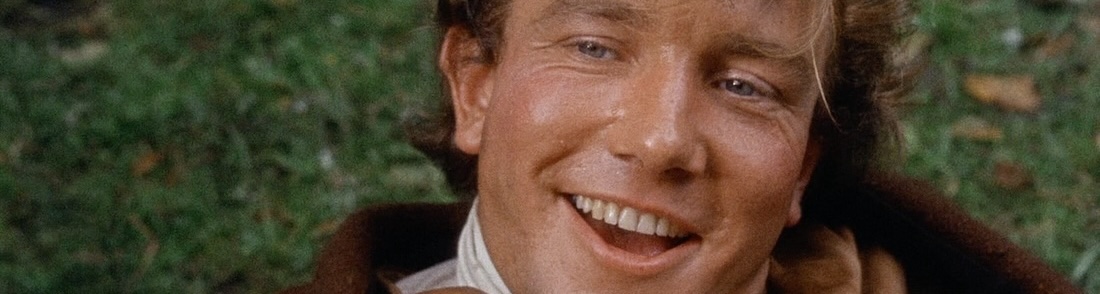
Tom foolery


It’s not unusual for Tom Jones to be loved by anyone.
It certainly was loved in 1963, when it won the best picture and best director Oscars, and was #4 at the US and British box office.
Do we love it today? I think only completists watch it today, and it isn’t a must-see anymore. I’m not very taken with it. But if we put ourselves in the minds of people at the time, we will realize that there weren’t movies like this then. It whooshed your eyeballs in 1963.
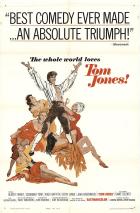
Country: United Kingdom.
Director: Tony Richardson.
Writer: John Osborne.
Based on: the novel The History of Tom Jones, a Foundling by Henry Fielding.
Cast includes: Albert Finney, Susannah York, Hugh Griffith, Edith Evans, Joan Greenwood, Diane Cilento, George Devine, David Tomlinson.
Links: Wikipedia, IMDB
Set in era: period.
Is it well known? well known.
How did I see it? home.
Had I seen this before? never before.
Compared to book: haven’t read it.
#4, US box office
#51, BFI Top 100 British Films
Academy Awards:
Supporting actress (nominated)
Actor (nominated)
Director (winner)
Best picture (winner)
Supporting actress (nominated)
Supporting actress (nominated)
Supporting actor (nominated)
Adapted screenplay (winner)
Golden Globes:
Supporting actress (nominated)
Supporting actor (nominated)
Actor musical/comedy (nominated)
Director (nominated)
Comedy or musical (winner)
BAFTA awards:
British screenplay (winner)
British actress (nominated)
British actor (nominated)
British actor (nominated)
British film (winner)
Best film (winner)
Most impressively, the movie is an adaptation of a novel from 1749. Well done, ahead-of-your-time 18th-century British author Henry Fielding, who also, according to Wikipedia, found time between novels to create London’s first professional police force.
The book’s full title is: “The History of Tom Jones, a Foundling,” and the movie starts with a jaunty silent-movie recounting of his “finding” as a baby. It’s a cute start, and in fact, it’s an introduction to the all-out mishmash of tales and styles that we’re in for.
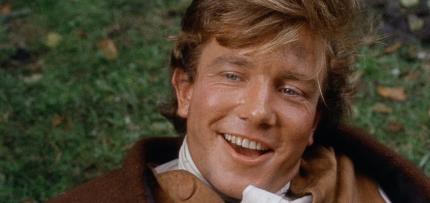
From the time he was born and found — um, foundled? — through his childhood to adulthood, young Tom’s life is charmed, merry and devil-may-care. Put in other words, as a title card does at the beginning of the movie, “The opinion of all was that he was born to be hanged.”
The lordly family on the next estate worries that Tom is hopelessly immoral. One of them accuses the vicar, “You have only taught Tom to laugh at whatever is decent and virtuous and right.”
“I’ve taught him religion!” the vicar answers.
I’m not sure whether that’s meant as a joke, but if so it’s a good one.
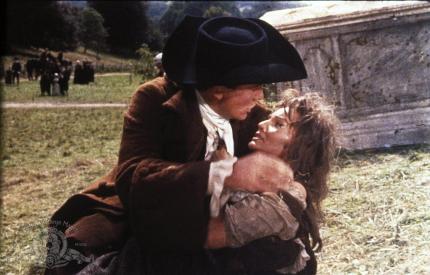
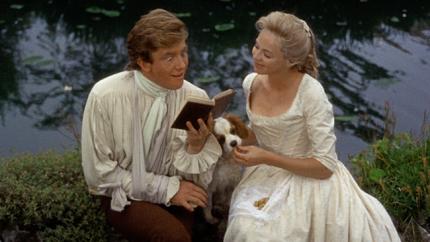
Tom — the dashing Albert Finney — has escapades with a number of slatternly, ruddy-skinned brunettes, though in his heart he really aspires to be with blonde, virginal Sophie, played by Susannah York. (York was described in her 2011 Telegraph obituary as “the blue-eyed English rose with the china-white skin and cupid lips,” according to Wikipedia, so that’s laying it on quite thick.) Added to this, every troublemaking woman in the movie seems to have an Irish or Australian accent. Maybe 1963 was a different time, but to me today, the Aryan aesthetic as well as the retrograde treatment of women jump right off the screen. Anyway, no time for that because . . .
Whoosh, off we go on a deer hunt filmed at breakneck speed from a speeding helicopter, with a pack of dogs in the chase and the whole estate riding horseback — and Tom coming up a hero. And off we go again and Tom is having an erotic (more like disgusting) foodgasm with another woman in another famous scene. And off Tom goes to the army, and then off he goes to London and into more romance and more trouble, ending up, as foretold, with a noose around his neck, and, well, who knows what will happen to this crazy dude next.
It was about as much fun and eye candy as a movie could be in 1963, and I can see why it won all the awards. Still, why do I just feel barely okay about it?
Well, I’ve just read an anthropology book from the 1980s called Orality and Literacy by Walter Ong, who talks about how thought, communication and narration styles are different in pre-literate cultures, and how they changed quite gradually as literacy developed. Ong points to Jane Austen as an author who really pioneered characters with interior lives and Edgar Allan Poe’s mysteries as having pioneered tight plotting. Before then, if you think about stories from the oral tradition into the earlier forms of novels, there was a lot of “This happened, and then that happened, and then that happened.”
Stories before then were episodic and with mental processes at surface level. I think about little kids, whose stories go like: “We did the alphabet, then we had lunch, then we did drawing, then we had naptime, then Bobby got in trouble for pulling Sally’s hair, then we had popsicles, then we came home.” It’s just thing to thing to thing. And think about the Odyssey as a pre-writing creation — if you’ve seen the movie, it gives Odysseus a little more of an interior life than the ancient Odysseus really had. Moral questioning? PTSD? Nah. He was a hero and a winner. Kind of like Tom!
The book points to the persistence of episodic tales into our literary era, and look for the surprise appearance of our dude here:
The addiction of Dickens and other nineteenth-century novelists to declamatory reading of selections from their novels also reveals the lingering feeling for the old oral narrator’s world. An especially persistent ghost from this world was the itinerant hero, whose travels served to string episodes together and who survived through medieval romances and even through Cervantes’ otherwise unbelievably precocious Don Quixote into Defoe (Robinson Crusoe was a stranded itinerant) and into Fielding’s Tom Jones.
That’s essentially why Tom Jones is not a grabber (well, he actually is a grabber, but the movie is less so): because his story is just one thing after another. There are some 1963 movies that remain a perfectly entertaining watch today because they are so well scripted — Charade, The Great Escape, and High and Low, to name three — and I don’t think Tom Jones is up there with them. It really is impressive that an 18th-century novel can be this successful as a 20th-century film, bravo to everyone involved, but it isn’t the one I’d spend two hours with.
Notes
1. At one point Tom falls in a pond, and I reflexively think: OH NO, HIS PHONE! This is not the only old movie where I have this thought.
2. From Wikipedia: Tom Jones is the only film in the history of the Academy Awards in which three actresses were nominated for the Academy Award for Best Supporting Actress. Margaret Rutherford won the category for her role in The V.I.P.s.
3. Film scholar Duncan Petrie speaks in a Criterion interview about the changes that Tom Jones represented:
It’s interesting to contrast it with the previous year’s Oscars, which, the big film that year was Lawrence of Arabia. Now, Lawrence of Arabia is another tremendous British picture of course, but if you contrast the style of Lawrence of Arabia, which is very much a classical film in the way it looks, feels, moves, the way it tells a story, with the freewheeling romp and kind of anything-goes of Tom Jones, that kind of shift from one year to the next really tells you a lot about how British cinema is changing at the time.
4. Director Tony Richardson had stories to tell about working with 60-year-old actor Hugh Griffith, who played Squire Western:
Part drunk, part amateur, wholly child, Hugh lived the part of Squire Western in real life. When you see him turn the horse like a corkscrew after he’s charged the steps of the Allworthy house, you’re not seeing something planned or rehearsed — he quite literally twisted the animal’s head so much that it reared, turned, and fell back on top of him. All the crew thought the weight of the horse would have split him open and killed him (if there was a frame more of the shot used in the film you would have seen assistants rushing in), but he was so drunk that the relaxation produced by the alcohol cushioned him completely.
Another day he somehow got hold of a shotgun and started trying to pot the crew as they were trailing home to sleep, and before he was overpowered he discharged a barrel into the roof of my T-bird.
He and Edith Evans, who played Miss Western, were an extraordinary contrast. She couldn’t stand him, but, being the great actress she was, she could understand how effective his personality was and always tried to make things work. Edith would arrive for rehearsal word-perfect, always on time, meticulously made up and costumed; Hugh would shamble in late, lurching, mumbling. Occasionally in exasperation she would give him a good swat with her parasol.
Tony Richardson, The Long Distance Runner: An Autobiography
5. Richardson also recalls the film’s nerve-wracking opening:
The prognosis was not good. The head of British distribution for United Artists saw the finished cut. He pronounced disaster: The film would be lucky if it made £40,000 worldwide. (At about the same time, Bud Ornstein, the head of British UA production, told the same gentleman that he’d just signed the Beatles for their first film. The distributor replied, “But who’s going to star?”)
The notices arrived and I remember coming down in a robe early in the morning and starting to read them. The Times said, “There is nothing in this film that could give any member of the audience one moment of enjoyment.” Vanessa came in with mugs of coffee. She looked at me. “It’s the usual story,” I said. We were inured to it.
But then, just like in the finale of The Threepenny Opera, the Queen’s messenger rode in and Macheath, on the scaffold, was given his reprieve. Lines were forming round the London Pavilion. Rock and roll had just broken through in England with the first impact of the Beatles. The sixties were starting to swing and Tom Jones became part of the “revolution.”
Tony Richardson, The Long Distance Runner: An Autobiography
The conversation
The New Yorker’s Brendan Gill was giddy over Tom Jones when it came out, trying to do with words what he felt the camera had done with his eyeballs:
Taking terrible chances and making no provision whatever for failure — a single slip and he might have broken every bone in his body — Mr. Richardson has somersaulted straight to triumph, and I suspect that his reward for having produced and directed a wellnigh perfect comedy of good old/bad old English days and ways will be the picture’s almost continual presence among us for many years to come. With the help of a wizard camera, which contrives to see what he sees even when, as in some of the hunting scenes, he is apparently in midair and upside down, Richardson flings himself pellmell through the ferny, sunny, sweaty greenness of a period and place that, whatever the facts of history may be, to our envious backward glance is all joyous appetite and consummation.
Brendan Gill, The New Yorker, 1963.
I haven’t been able to access the condemnatory Times of London review that Richardson cites, but if I do get hold of it in the future, I’ll add it. Meanwhile, here are some more reactions:
In finding a means of cinema expression in which to convey most suitably to our age the deceptively fastidious rhetoric and ribald wit of the Fielding work, Mr. Richardson and his scenarist, John Osborne of “Angry Young Man” fame have worked out a structure and a rhythm that constitute a major creative achievement in themselves. Their attack on the lusty old novel is completely away from the line of a standard-movie treatment, with its usual endeavor to put a naturalistic reproduction of the original into pictorial terms. And they have whipped up a roaring entertainment that develops its own energy as much from its cinematic gusto as from the racy material it presents.
Bosley Crowther, Screen: ‘Tom Jones,’ a Lusty Comedy, The New York Times, 1963
It still feels somewhat fresh and unexpected to the modern viewer, simply because it isn’t really like any film released in the intervening 45 years. With the very rare exception like Sofia Coppola’s Marie Antoinette, costume dramas that look and feel like contemporary movies are extraordinarily unusual, for even today we expect that films set prior to the invention of electric lighting should be fussy and stuffy and chock full of people with British accents wrapping their mouths around sentences with eight clauses. To be fair, there’s some of that in Tom Jones, but used in a very particular way: all of the characters who represent the Proper Aristocracy, opposed to Tom’s mischievousness, behave like Masterpiece Theater stock figures (David Warner as Tom’s rival Mr Blifil, Peter Bull as the censorious religious tutor Mr Thwackum), while those more inclined to indulge Tom are a bit more silly and modern in representation (his adopted father Squire Allworthy, played by George Devine, Hugh Griffith’s marvelous turn as the gaudy Squire Western), right up to the young punks who don’t give a damn about propriety, acting like they just stepped out of a Dick Sellers comedy - Finney’s Tom of course, or Susannah York as his love Sophie Western.
Tim Brayton, AlternateEnding.com, 2008
Country: United Kingdom.
Director: Tony Richardson.
Writer: John Osborne.
Based on: the novel The History of Tom Jones, a Foundling by Henry Fielding.
Cast includes: Albert Finney, Susannah York, Hugh Griffith, Edith Evans, Joan Greenwood, Diane Cilento, George Devine, David Tomlinson.
Links: Wikipedia, IMDB
Set in era: period.
Is it well known? well known.
How did I see it? home.
Had I seen this before? never before.
Compared to book: haven’t read it.
#4, US box office
#51, BFI Top 100 British Films
Academy Awards:
Supporting actress (nominated)
Actor (nominated)
Director (winner)
Best picture (winner)
Supporting actress (nominated)
Supporting actress (nominated)
Supporting actor (nominated)
Adapted screenplay (winner)
Golden Globes:
Supporting actress (nominated)
Supporting actor (nominated)
Actor musical/comedy (nominated)
Director (nominated)
Comedy or musical (winner)
BAFTA awards:
British screenplay (winner)
British actress (nominated)
British actor (nominated)
British actor (nominated)
British film (winner)
Best film (winner)