Who you callin’ ugly?


The title is a bit of an insult, isn’t it? It’s meant to get a rise out of you, and it’s worth asking, who and what is the ugly American?
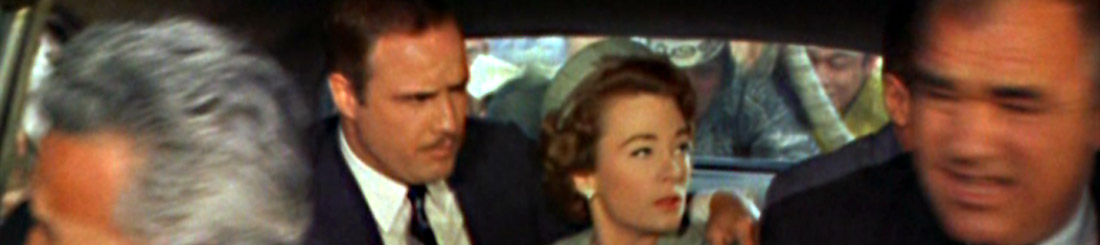
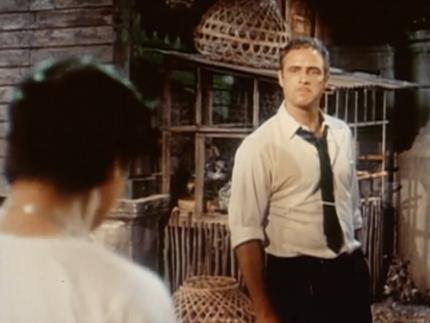
Is it Marlon Brando? He plays (not at all ugly-ly) Harrison MacWhite, the American ambassador to a fictional country in Southeast Asia, who knows a little bit about the country from having served in the war, but, as it turns out, not enough.
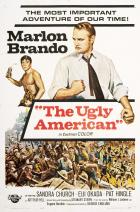
Country: United States.
Running time: 120 minutes.
Director: George Englund.
Writer: Stewart Stern.
Cast includes: Marlon Brando, Sandra Church, Eiji Okada, Pat Hingle, Judson Pratt, Reiko Sato, Arthur Hill.
Links: Wikipedia, IMDB
Actor drama (nominated)
Director (nominated)
Keywords: government, foreign affairs.
Set in era: contemporary.
Is it well known? well known.
How did I see it? home.
Had I seen this before? never before.
Compared to book: book is better.
The movie comes from a rather famous 1958 novel, which I read about a year ago, and it prunes the book down pretty ruthlessly, which is both the right and wrong move.
The book is barely a novel — it’s a loose series of vignettes that hopscotch around Southeast Asian locales trying to teach Americans, well, not really about Southeast Asia as much as what makes the diplomatic face of the United States ugly, or not ugly, abroad.
The movie takes this idea and hones it into a single story — in which our man MacWhite is sent to the (fictional) nation of Sarkhan to improve relations there amid rising tension and communist infiltration. He has a friend from the war days, Deong, who he thinks will be an important ally once he gets there but who turns out to be an unreliable friend of the United States’s preferred regime, and to the American ambassador himself.
Brando’s character knows just the thing to beat the communists — a “Freedom Road.” And this road should be diverted from its current non-threatening east-west path directly north toward (unstated) the border with China. “It would drive a harpoon right into the heart of the communist concentration!” MacWhite tells the Sarkhanese prime minister.
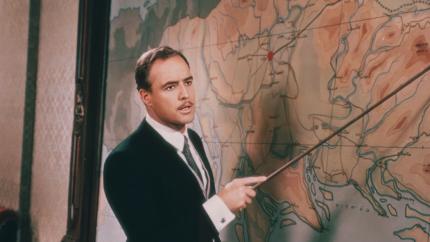
(It’s a misfire that this man wearing a military uniform in a palace is referred to as the “prime minister” of the country, which would be a civilian legislative role. He borders on a dictator and should be called the president, if not general or king, in the script.)
This is the essence of the “ugly American” — barging into a country he minimally understands and demanding grand measures that will only make things worse, which he might comprehend if he had greater awareness of what’s happening at the popular level. The book makes this point much more thoroughly. The American’s arrogance opens the door to communist subversion — which in the case of this movie is being done with the cooperation of his own so-called friend in the country.
The movie mixes some really harrowing riot and attack scenes with some surprisingly unmovielike scenes of bureaucracy bureaucratizing. We sit through MacWhite’s Senate confirmation hearing for about 10 minutes, the most interesting part of which is contemplating The Wild One / Stanley Kowalski wearing a suit and smoking a pipe. Once installed as ambassador, he is given killer dialogue like: “I am thoroughly aware of your reservations, Mr. Prime Minister, and everyone else’s reservations about this matter, but I cannot in good conscience say that I accept them as valid.”
So in the end, who and what is the ugly American? I don’t think this will really come across in the movie. The book had a very specific axe to grind that the movie mostly doesn’t, and that is: The American foreign service can be effective only by being close to the ground, knowing the language, knowing the people, places and customs, and building trust. It is full of examples of military and civilian characters who work effectively within foreign cultures and others who live arrogantly above them. It is said to have been instrumental in the creation of the Peace Corps in 1961. I would retroactively like to retitle it, Don’t Do A Vietnam War You’ll Be Sorry.
Most of this meaning is lost in the movie. Maybe a little bit of it squeaks through. Brando is a pretty arrogant American, and there is a couple in the film living among the people as in the book.
The movie ends (spoiler, obviously) with Brando addressing television cameras in the embassy after a disastrous conclusion to our story. For some reason, his speech is being broadcast live on American television — I guess we’ll just accept that.
“I’ve learned that the only time we’re hated is when we stop trying to be what we started out to be 200 years ago,” he says.
This isn’t really the point at all. Okay, continue.
“I’m not blaming my country. I’m blaming the indifference that some of us show to its promises. If the Cold War disappeared right now, the American people would still be in this fight against ignorance and hunger and disease, because it’s right. It’s right. It’s right to be in it. And if I have one appeal to make to every American, it would be that —"
And suddenly we see a man in an ordinary American home flick off the TV midsentence. We’ve finally found him — the ugly American. The one sitting at home who Doesn’t Care. What about you? You’re not like him, are you?
The movie is just okay in every way. It tells a story that didn’t really demand to be told, with a successful book as a roadmap that it didn’t follow. I think this kind of movie has a grand ambition — its title alone is a very big challenge — and the result is very small. Coming exactly when the country was putting military advisers in Vietnam and two years before we were fully involved in an ugly American war there, it could have done so much more.
Notes
Director George Englund (1926-2017) went on to do the following films, none of which I know:
- Signpost to Murder (1965)
Zachariah (1971)
Snow Job (1972)
A Christmas to Remember (1978, TV movie)
The Vegas Strip War (1984, TV movie)
He was best friends with Brando, according to Wikipedia. Also, he was married to Cloris Leachman from 1953 to 1978!
The conversation
Much as happened in the case of It’s a Mad, Mad, Mad, Mad World, the Times critic agreed with me about this film too . . .
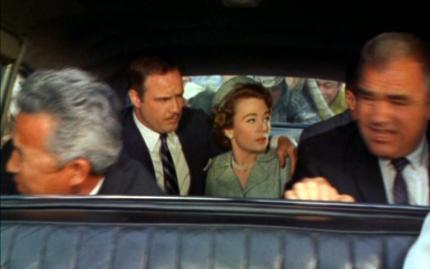
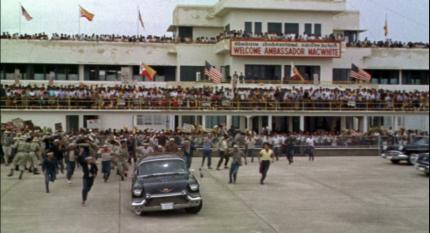
Mr. Brando’s brilliant acting of mingled surprise and sweaty fear when confronted by a mob of ugly, violent anti-American demonstrators upon his arrival in Sarkhan puts such reality into the incident — as does the excellence with which it is staged — that it looks at this point as though this picture is going to be a ball of fire. Well, it never becomes that, exactly, because shortly after this scene it subsides into some devious plot maneuvers that are just too corny, calculated and naïve.
Bosley Crowther, ‘The Ugly American’ Opens: Marlon Brando Stars as the U.S. Diplomat, The New York Times, 1963
. . . while the New Yorker critic had his nose a little too far in the air, getting it quite wrong.
“The Ugly American” is a pleasant surprise, in part because it bears so little resemblance to the book from which it takes its name, and in part because its star, Marlon Brando, gives a performance as dazzling as his performance in “Mutiny on the Bounty” was dim. William J. Lederer and Eugene Burdick, in a foreword to the novel, instructed their readers that “this book is written as fiction; but it is based on fact,” and that “the names, the places, the events, are our inventions; our aim is not to embarrass individuals, but to stimulate thought — and, we hope, action.”
With a few exceptions, this is a wretched reason for writing fiction — ”Uncle Tom’s Cabin” may have helped the slaves, but “Moby Dick” didn’t do much for whales — and the Lederer-Burdick work amounted to little more than a series of loosely hammered-together parables about our State Department’s inveterate bungling in Southeast Asia.
We should all be grateful that Stewart Stern, who wrote the screenplay of “The Ugly American,” hasn’t felt the slightest twinge of piety toward the original. Instead, he has given us a seductively direct, slam-bang, and, for much of its length, believable melodrama.
Brendan Gill, Good news, bad news, The New Yorker, 1963
Country: United States.
Running time: 120 minutes.
Director: George Englund.
Writer: Stewart Stern.
Cast includes: Marlon Brando, Sandra Church, Eiji Okada, Pat Hingle, Judson Pratt, Reiko Sato, Arthur Hill.
Links: Wikipedia, IMDB
Actor drama (nominated)
Director (nominated)
Keywords: government, foreign affairs.
Set in era: contemporary.
Is it well known? well known.
How did I see it? home.
Had I seen this before? never before.
Compared to book: book is better.